How Purdue University Solves a Difficult DMSO Removal Challenge
Post date : May 15, 2026 Update date : July 01, 2026
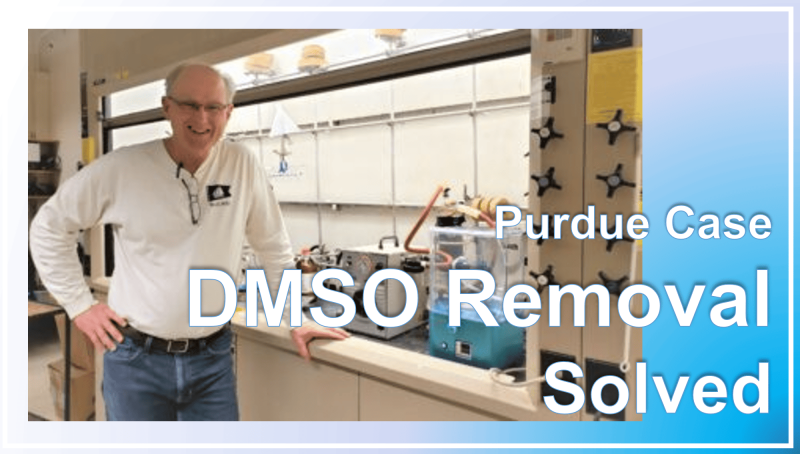
DMSO removal becomes difficult when extraction is not applicable and lyophilization is inefficient.
See how a Purdue University case solved this challenge using the Smart Evaporator.
This article introduces a real case from Purdue University, explaining how a difficult DMSO removal workflow was addressed and what insights can be applied to similar laboratory situations.
Table of Contents
- The Challenge of DMSO Removal
- Why the Smart Evaporator Was Introduced
- Why DMSO-Free Formulation Matters
- Container Flexibility in Real Lab Use
- Applications Beyond DMSO Removal
- Conclusion
- FAQ
- Related Links
The Challenge of DMSO Removal
DMSO removal becomes especially difficult when extraction is not applicable and lyophilization does not provide a practical solution.
The following comments are from Dr. Davisson at Purdue University.
We needed to produce a chemical compound in DMSO-containing water, from which the compound has to be isolated as a dry powder. That is, isolation and purification of DMSO-free materials from DMSO-containing mixture.
This material (compound) is miscible to water, therefore is impossible to be isolated by conventional extraction with organic solvent (for removing DMSO). Technically DMSO removal is said as possible by lyophilization, however DMSO removal takes forever and incomplete.
This highlights a typical limitation where existing methods fail to efficiently produce DMSO-free dry material.
Why the Smart Evaporator Was Introduced
The Smart Evaporator was introduced to address a limitation that could not be solved using conventional methods.
We have decided to acquire one unit because there was a problem that has been impossible to resolve by existing methods.
This clearly shows that the Smart Evaporator was not introduced as a replacement, but as a solution to a specific unmet need.
Why DMSO-Free Formulation Matters
DMSO removal is essential when the downstream application requires DMSO-free formulation.
FDA does not approve DMSO formulation for human administration. DMSO removal for practical time/scale is truly a significant unmet need from pharmaceutical aspect.
It will be formulated in common buffer like PBS for administrating to animals such as mouse and rats via injection or oral, which is acceptable only with DMSO-free formulation.
This means DMSO must be removed before the compound can be used in actual experiments. The Smart Evaporator provides a practical way to achieve this, which is why it is highly valued in such workflows.
Container Flexibility in Real Lab Use
Compatibility with a wide range of containers is one of the key features of the Smart Evaporator.
Not just vials, but we are trying with various containers of various shapes.
This comment suggests that researchers are exploring its use with different container types, indicating the potential to expand its applicability across various workflows.
Applications Beyond DMSO Removal
The Smart Evaporator is not limited to DMSO removal. It is compatible with a wide range of solvents, from low-boiling to high-boiling solvents, making it applicable to various evaporation and concentration workflows.
The unit should be applied not only for DMSO removal but also concentrating HPLC fraction e.g. peptide purification.
Due to this compatibility, the Smart Evaporator can support a broad spectrum of research workflows.
Conclusion
This Purdue University case demonstrates how the Smart Evaporator can address difficult evaporation challenges where conventional methods are not practical.
It provides a practical approach for recovering DMSO-free dry material while maintaining compatibility with real lab workflows.
FAQ
Can it handle solvents other than DMSO?
Yes. In addition to DMSO, the Smart Evaporator is compatible with a wide range of solvents used in laboratory workflows.
This makes it applicable not only for DMSO removal, but also for general evaporation, concentration, and drying tasks.
Will I need to change my current workflow?
In many cases, no major workflow change is required. As shown in the Purdue University case, various container types such as vials and flasks can be used.
This flexibility allows integration into existing lab workflows without significant changes.
What kind of situations is this most useful for?
This approach is particularly useful when extraction is not applicable, lyophilization is too slow or incomplete, or DMSO-free dry material is required.
It may also be useful for workflows such as HPLC fraction concentration and peptide purification.
Do I need to monitor the process constantly?
No. The Smart Evaporator is designed to allow stable evaporation without constant supervision.
This means you can continue other lab work while evaporation is in progress, reducing time spent monitoring the process.
Can I actually see how it works before deciding?
Yes. You can request a live demonstration where you can see the Smart Evaporator in action and understand how it works in real laboratory conditions.
During the demo, you can observe evaporation behavior, ask about your solvents, and discuss whether it fits your workflow in detail.