How UCI Researchers Reduced Water-Based Sample Drying by 75%
Post date : July 21, 2026 Update date : July 21, 2026
Key Takeaway
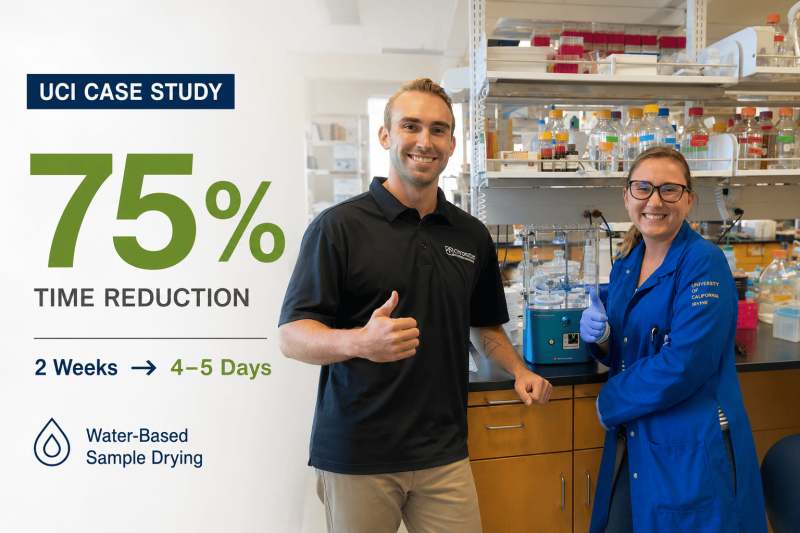
UCI researchers reduced a two-week purification workflow to 4–5 days using Smart Evaporator™.
For water-based reactions and aqueous samples, faster drying helped reduce workflow bottlenecks and accelerate research progress.
Drying water-based samples can be one of the most time-consuming steps in pharmaceutical and chemistry research workflows.
While many laboratory processes are designed around conventional organic solvents, aqueous reactions and water-rich fractions often require much longer drying times. For researchers who need to move from reaction to purification and final product, this waiting time can slow down the entire workflow.
At the University of California Irvine (UCI), researchers faced this issue while working with water-based reactions. This case study is based on feedback from Teodora “Tia” Nedic, who was a PhD student in Pharmaceutical Sciences at UCI at the time of the evaluation. She reported that Smart Evaporator™ helped reduce her product preparation timeline by 75%.
Interested in learning whether Smart Evaporator™ could apply to your samples?
Discuss your application in a short online demonstration.→
Why Are Water-Based Samples Difficult to Dry?
Water-based samples often take longer to dry than samples prepared in many conventional organic solvents. This can make aqueous workflows more difficult to manage, especially when drying is required multiple times during a research process.
Researchers working with aqueous samples may encounter challenges such as:
- Long drying times
- Overnight drying steps
- Multiple rounds of drying before and after purification
- Delays between reaction, HPLC purification, and final product recovery
- Reduced productivity when samples take days to dry
In research environments where speed matters, drying time can become a major bottleneck.
The Challenge Faced by UCI Researchers
According to Ms. Teodora “Tia” Nedic, her research involved chemical synthesis to conjugate two products together. The challenge was that her reactions took place in water.
Before using Smart Evaporator™, the workflow involved several time-consuming steps:
- Performing a reaction using at least 3 mL of water
- Drying the sample on a Schlenk line overnight
- Resuspending the sample in a smaller volume for HPLC
- Collecting HPLC fractions
- Drying the collected fractions again
The final drying step could involve more than 15 mL of water, requiring multiple days of drying. From reaction to purified product, the full workflow could take up to two weeks.
Common Drying Methods for Water-Based Samples
Several methods can be used to dry or concentrate water-based samples. The most suitable option depends on sample volume, container type, workflow requirements, and how quickly researchers need to proceed to the next step.
| Method | Advantages | Limitations |
|---|---|---|
| Schlenk Line | Common in synthesis laboratories | May require overnight or extended drying |
| Freeze Dryer | Useful for aqueous samples | Drying can take days depending on the sample |
| Rotary Evaporator | Suitable for larger volumes | Less convenient for small fractions or repeated drying steps |
| Smart Evaporator™ | Direct evaporation in sample containers | Best suited for small to medium volumes |
How Smart Evaporator™ Improved the Workflow
After introducing Smart Evaporator™, the UCI researcher reported a major improvement in preparation time.
One reason for this improvement is the evaporation principle used by Smart Evaporator™. Unlike vacuum-based systems, it operates under atmospheric pressure and is designed to prevent bumping in principle. This enables efficient concentration of water-based samples while reducing the need for constant monitoring during evaporation.
15-Second UCI Evaluation Video
This short video captures the actual moment immediately after evaporation during the UCI evaluation.
After seeing the concentrated sample, the researcher spontaneously responded, “Oh my god!”, reflecting the immediate impact of the result.
Original evaluation footage from the University of California Irvine (UCI).
The original two-week timeline was reduced to 4–5 days, representing a 75% reduction in the time required to obtain the purified product.
For water-based samples, this improvement was especially meaningful because drying had previously been one of the most time-consuming steps in the workflow.
- Workflow reduced from two weeks to 4–5 days
- Product preparation time reduced by approximately 75%
- Water-based samples dried in hours instead of days
- Researchers reached results more quickly
- Aqueous experiments became easier to incorporate into routine workflows
Could This Workflow Fit Your Research?
If you’re working with water-based samples or other challenging solvents, our team can help evaluate whether this workflow could benefit your research.
The comments below are selected excerpts from the original UCI evaluation. For the complete interview and additional feedback from the research team, read the full testimonial.
Researcher Perspective
“Since the purchase of the Smart Evaporator™, my 2-week timeline has been cut down to 4–5 days. This means I am producing faster, and thus, progressing science. I am eternally grateful for this device and all of the time it has saved me.”
Teodora “Tia” Nedic
then a PhD Student in Pharmaceutical Sciences at the University of California Irvine (UCI)
The UCI team also shared feedback from another member of the research group who worked with aqueous samples.
“The Smart Evaporator™ speeds up my workflow by a lot. In the past I used to dread aqueous based samples because each experiment would take days to evaporate on our lyophilizer.”
“Nowadays, water based experiments take much less time since my samples dry in a few hours. This lets me get to my result faster, and now I don’t stray away from water as much anymore.”
Research Team Member
University of California Irvine (UCI)
Key Results
Measured Impact at UCI
- Product preparation time reduced by 75%
- Workflow shortened from 2 weeks to 4–5 days
- Water-based samples dried in hours rather than days
- Faster access to purified products
- Improved research productivity
| Before Smart Evaporator™ | After Smart Evaporator™ |
|---|---|
| Up to 2 weeks from reaction to purified product | 4–5 days |
| Overnight drying on a Schlenk line | Product preparation time reduced by 75% |
| Final fractions could require multiple days of drying | Water-based samples dried in a few hours |
| Aqueous samples were something researchers could dread | Water-based experiments became less burdensome |
What Researchers Gained
Shorter Waiting Time
Drying steps that previously took overnight or multiple days were significantly shortened, helping researchers move through their workflow faster.
Faster Access to Results
When samples dry faster, researchers can move more quickly from reaction to purification and final product recovery.
More Practical Water-Based Experiments
One researcher noted that faster drying helped reduce hesitation around aqueous samples, making water-based experiments feel less burdensome.
Conclusion
The UCI user evaluation shows how drying water-based samples can become a major bottleneck in research workflows.
Before using Smart Evaporator™, one researcher reported that the process from reaction to purified product could take up to two weeks. After introducing Smart Evaporator™, that timeline was reduced to 4–5 days.
For laboratories working with aqueous reactions or water-rich samples, reducing drying time can help accelerate sample preparation, improve productivity, and support faster research progress.
Related Articles
DMF vs. DMSO Evaporation: Removing Difficult Solvents in Labs
Compare two of the most challenging laboratory solvents and learn practical evaporation strategies for each.
Why DMF Solvent Removal Is Difficult
Understand why DMF is difficult to remove and explore practical approaches for improving evaporation efficiency.
Simple & Safe Solvent Evaporation
Explore practical solvent evaporation methods that help improve safety, efficiency, and everyday laboratory workflows.
Could This Approach Benefit Your Research?
If you’re facing similar challenges with water-based samples or other difficult solvents, we’d be happy to discuss whether this workflow could fit your application.