How Oxford Handles DMSO Evaporation in Medicinal Chemistry
Post date : July 15, 2026 Update date : July 15, 2026
Solvent evaporation is a routine step in medicinal chemistry, but it can still create practical bottlenecks when laboratory teams need to remove high-boiling solvents such as DMSO, avoid sample loss, and prepare compounds for downstream biological evaluation.
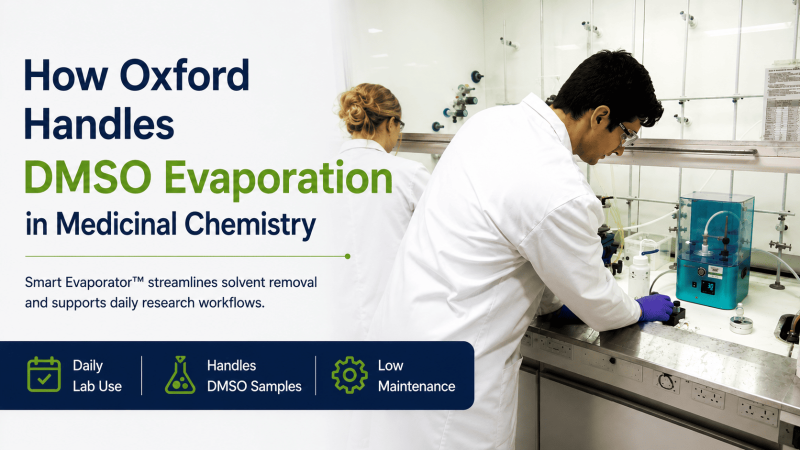
At the Chemistry Research Laboratory, University of Oxford, Smart Evaporator™ has been used in daily medicinal chemistry operations, including solvent removal from target compounds, isolation of synthetic intermediates, recovery of NMR samples, and evaporation of samples containing DMSO.
This article explains why DMSO evaporation remains challenging in medicinal chemistry and how Smart Evaporator™ supports practical sample concentration workflows in research laboratories.
Contents
Why Solvent Evaporation Still Slows Medicinal Chemistry
In medicinal chemistry laboratories, solvent evaporation is one of the most common but often underestimated tasks. Medicinal chemists repeatedly remove solvents from synthetic intermediates, concentrate target compounds, recover NMR samples, and prepare materials for biological screening.
Despite advances in analytical instruments and automated research platforms, many evaporation workflows still depend on conventional methods such as rotary evaporators, nitrogen blowdown evaporators, or centrifugal evaporators.
- Bumping risk under reduced pressure
- Slow removal of high-boiling solvents such as DMSO or DMF
- Sample transfer between dedicated vessels
- Limited container compatibility
- Large equipment footprints inside crowded fume hoods
- Time spent checking evaporation progress
- Maintenance and training requirements
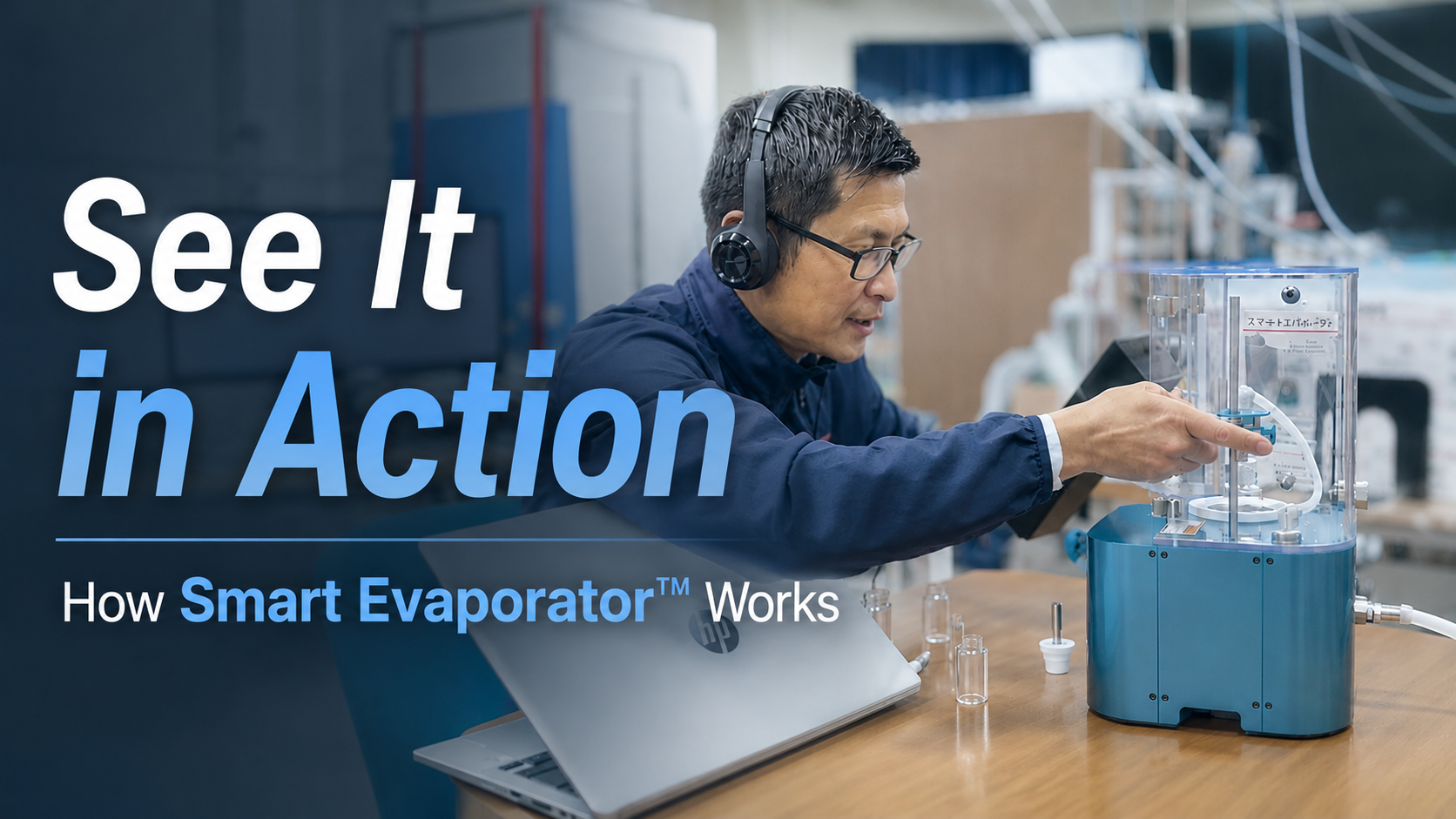
Interested in seeing the evaporation mechanism in practice?
🗓️ Request a Live Demo ›How Oxford Uses Smart Evaporator™
According to a testimonial from the Chemistry Research Laboratory at the University of Oxford, Smart Evaporator™ was used daily within medicinal chemistry workflows for several months.
- Removing solvents from target compounds before biological screening
- Isolating synthetic intermediates
- Recovering NMR samples from solution
- Evaporating samples containing DMSO
- Supporting routine medicinal chemistry sample concentration
The Oxford laboratory highlighted the importance of reliable trace solvent removal before compounds are submitted for biological evaluation.
In medicinal chemistry workflows, incomplete solvent removal can affect downstream assays, reproducibility, and analytical reliability.
The Oxford use case shows Smart Evaporator™ being applied as a practical daily evaporation platform, not only as a specialized device for one unusual solvent.
Why DMSO Is Difficult to Evaporate
Dimethyl sulfoxide, or DMSO, is widely used in medicinal chemistry, pharmaceutical research, compound libraries, and biological screening because of its strong solvating capability.
However, its high boiling point makes it a hard-to-remove solvent for many conventional evaporation methods.
- Very slow evaporation
- Residual solvent remaining in the sample
- Bumping caused by vacuum reduction
- Sample loss during concentration
- Long monitoring time
- Difficulty reaching dryness safely
Traditional rotary evaporation systems rely on reduced pressure. While effective for many volatile solvents, vacuum reduction can increase bumping risk, especially with challenging solvent systems or small-volume samples.
Nitrogen blowdown systems do not create bumping in the same way because they are not vacuum-based. However, high-boiling solvents can still be difficult to evaporate efficiently by nitrogen blowdown alone.
Evaporation Beyond Reduced-Pressure Methods
Unlike conventional rotary evaporators, Smart Evaporator™ uses the VVC method. Instead of relying primarily on reduced-pressure evaporation, the device continuously introduces spiral airflow into the container.
This airflow forms a vortex near the liquid surface and accelerates evaporation efficiently under atmospheric pressure conditions.
Instead of relying primarily on reduced-pressure evaporation, Smart Evaporator™ fundamentally minimizes bumping risk during operation.
High-Boiling Solvents
- DMSO
- DMF
- Water-containing mixtures
- Other difficult solvent systems
Laboratory teams can concentrate samples without relying on aggressive vacuum reduction that may destabilize the sample or cause sudden bumping.
Less Monitoring
Many conventional evaporation workflows require researchers to constantly watch the sample condition to avoid bumping, overflow, or sample loss.
Because Smart Evaporator™ uses a different evaporation mechanism, researchers do not need to continuously monitor the sample in the same way as they often do with vacuum-based evaporation.
Container Flexibility
Traditional rotary evaporators typically depend on dedicated evaporation flasks. By contrast, Smart Evaporator™ supports a wide variety of containers.
- Reduce sample transfer steps
- Minimize contamination risk
- Preserve valuable compounds
- Improve laboratory handling
- Use the same container across multiple steps
Compact, Low-Maintenance Design
The Oxford testimonial also mentions that Smart Evaporator™ occupies only a small footprint within the fume hood and requires little or no maintenance.
Why This Matters in Medicinal Chemistry
Medicinal chemistry research is highly iterative. Researchers repeatedly synthesize compounds, concentrate samples, evaluate purity, recover intermediates, and submit materials for biological testing.
- Delay compound submission
- Reduce analytical throughput
- Increase researcher workload
- Introduce sample handling risks
- Slow medicinal chemistry optimization cycles
The Oxford testimonial demonstrates that Smart Evaporator™ became broadly useful across daily medicinal chemistry operations rather than only one specialized task.
Comparing Common Evaporation Methods
| Feature | Smart Evaporator™ | Rotary Evaporator | Nitrogen Blowdown | Centrifugal Evaporator |
|---|---|---|---|---|
| Bumping Risk | Fundamentally minimized | Moderate to High | None | Moderate |
| DMSO Compatibility | Highly compatible | Moderate | Limited to Moderate | Moderate |
| Container Flexibility | High | Limited | Moderate | Limited |
| Monitoring Requirement | Low | High | Moderate | Moderate |
| Maintenance Burden | Low | Moderate | Low | Moderate |
| Footprint | Compact | Large | Moderate | Large |
| Deep Vacuum Required | No | Yes | No | Yes |
- Ease of daily use
- Reliable solvent removal
- Practical DMSO handling
- Stable sample concentration
- Low maintenance
- Compact installation
For a medicinal chemistry laboratory, the value of an evaporation system is not measured only by whether it can remove solvent. It is also measured by whether it helps researchers move from synthesis to biological evaluation with fewer interruptions and lower risk of sample loss.
Conclusion
The University of Oxford testimonial demonstrates how Smart Evaporator™ supports practical medicinal chemistry workflows beyond simple solvent evaporation.
Whether the goal is removing trace solvent before biological screening, recovering NMR samples, or handling difficult high-boiling solvents, Smart Evaporator™ provides a practical solution already being used in advanced research laboratories including the University of Oxford.
FAQ
Can DMSO be evaporated completely?
Yes, DMSO can be evaporated completely, but many conventional evaporation methods require long processing times or careful monitoring because of its high boiling point. Smart Evaporator™ supports DMSO evaporation using airflow-based concentration rather than depending primarily on reduced-pressure evaporation.
Why is bumping dangerous during solvent evaporation?
Bumping can suddenly eject sample material during evaporation, leading to sample loss, contamination, and reduced reproducibility. This is especially problematic in medicinal chemistry workflows handling valuable compounds or limited-scale intermediates.
Why remove solvents before biological screening?
Residual solvent can affect biological assay accuracy and compound evaluation results. Medicinal chemistry laboratories therefore often require reliable trace solvent removal before submitting compounds for screening.
Which solvents are difficult to evaporate?
Common difficult solvents include DMSO, DMF, water-containing mixtures, and other highly polar solvent systems. These solvents often require extended evaporation time using conventional concentration methods.
Why atmospheric pressure evaporation?
Atmospheric-pressure evaporation can help reduce instability that may occur during reduced-pressure evaporation
Related Information
- Learn more about Smart Evaporator™
- Read the University of Oxford testimonial
See Smart Evaporator™ in a Live Demo
Watch how the live demonstration works, then request your own online session.
📅 Request a Live Demo