Nitrogen Blowdown and Other Evaporation Methods Compared
Post date : July 02, 2026 Update date : July 02, 2026
Nitrogen blowdown evaporation is widely used in laboratories for small-volume sample preparation because it offers a simple setup and supports parallel processing. However, when researchers handle high-boiling solvents, difficult samples, or workflows that require close endpoint control, they may need to compare nitrogen blowdown with other evaporation methods.
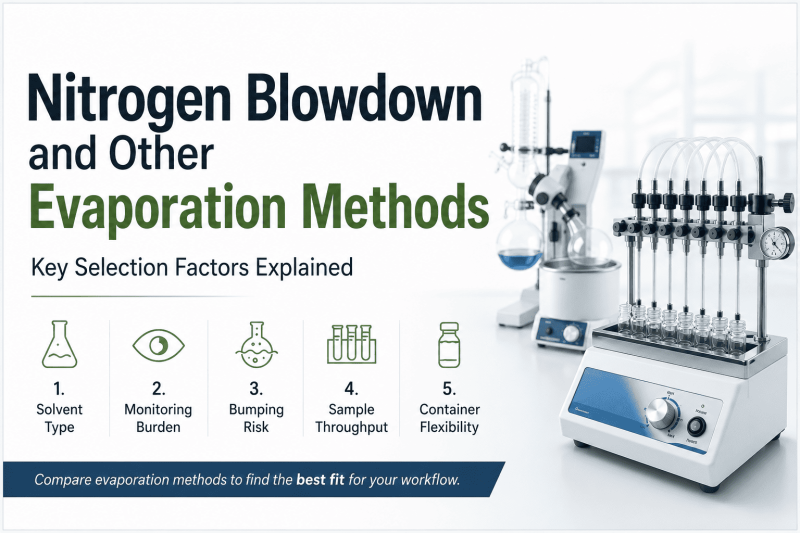
Quick answer: The best solvent evaporation method depends on solvent type, monitoring burden, bumping risk, sample throughput, and container flexibility. The comparison table below summarizes these key selection factors before explaining each point in more detail.
| Method | Solvent Type High-Boiling Solvents |
Monitoring Burden | Bumping Risk | Sample Throughput | Container Flexibility |
|---|---|---|---|---|---|
| Nitrogen Blowdown | Moderate | Medium | None | High | High |
| Rotary Evaporator | Condition-dependent | Higher | Moderate to High | Limited | Limited |
| Centrifugal Evaporator | Moderate to High | Medium | Moderate | Very High | Moderate |
| Freeze Dryer | Limited | Lower | Lower | Medium | Moderate |
| Smart Evaporator™ | High | Lower | Very Low | Medium | High |
This table is intended as a practical starting point. Actual performance depends on solvent, sample volume, equipment settings, and workflow conditions.
Working with DMF or DMSO?
Explore how laboratories approach difficult solvent evaporation under atmospheric pressure.
Table of Contents
- What Is Nitrogen Blowdown Evaporation?
- Why Evaporation Method Selection Matters
- Selection Factor 1: Solvent Type
- Selection Factor 2: Monitoring Burden
- Selection Factor 3: Bumping Risk
- Selection Factor 4: Sample Throughput
- Selection Factor 5: Container Flexibility
- FAQ
- Summary
What Is Nitrogen Blowdown Evaporation?
Nitrogen blowdown evaporation removes solvent by directing dry nitrogen gas onto the liquid surface. The gas flow helps remove solvent vapor and promotes evaporation.
This method is commonly used in analytical chemistry and LC/MS sample preparation where multiple small-volume samples need to be concentrated in parallel.
| Aspect | Nitrogen Blowdown Evaporation |
|---|---|
| Basic principle | Uses dry nitrogen gas to remove solvent vapor from the liquid surface |
| Best suited for | Parallel concentration of multiple small-volume samples |
| Main strengths | Simple setup, parallel processing, relatively mild operating conditions |
| Main limitations | Slower evaporation of high-boiling solvents and less precise endpoint control near dryness |
Why Evaporation Method Selection Matters
Researchers often compare evaporation methods when they encounter slow solvent removal, bumping, constant monitoring requirements, difficulty controlling the endpoint near dryness, or workflow bottlenecks caused by evaporation.
For this reason, practical evaporation method comparison should focus not only on speed, but also on how the method fits the actual laboratory workflow.
Selection Factor 1: Solvent Type
The solvent itself strongly affects evaporation behavior. High-boiling solvents such as DMF and DMSO often require longer evaporation times and may increase operator burden during concentration.
| Method | High-Boiling Solvent Compatibility |
|---|---|
| Nitrogen Blowdown | Moderate*Limited for DMF/DMSO |
| Rotary Evaporation | Condition-dependent |
| Centrifugal Evaporation | Moderate to High |
| Freeze Drying | Limited |
| Smart Evaporator™ (Atmospheric-pressure evaporation) |
High |
Selection Factor 2: Monitoring Burden
Monitoring burden is another important factor when selecting an evaporation method. Some workflows require researchers to watch the sample closely, adjust conditions, or stop evaporation at the desired endpoint.
| Method | Monitoring Burden |
|---|---|
| Nitrogen Blowdown | Medium |
| Rotary Evaporation | Higher |
| Centrifugal Evaporation | Medium |
| Freeze Drying | Lower |
| Smart Evaporator™ (Atmospheric-pressure evaporation) |
Lower |
Interested in reducing monitoring time?
Explore Smart Evaporator™ applications for difficult solvent workflows.
Selection Factor 3: Bumping Risk
Bumping can affect reproducibility, sample recovery, and operator stress during solvent evaporation. For valuable or small-volume samples, reducing unexpected sample loss can be an important selection factor.
| Method | Bumping Risk |
|---|---|
| Nitrogen Blowdown | None |
| Rotary Evaporation | Moderate to High |
| Centrifugal Evaporation | Moderate |
| Freeze Drying | Lower |
| Smart Evaporator™ (Atmospheric-pressure evaporation) |
Very Low |
Selection Factor 4: Sample Throughput
Different evaporation methods fit different throughput needs. Researchers should compare sample number, sample volume, and workflow scale before selecting a method.
| Method | Sample Throughput |
|---|---|
| Nitrogen Blowdown | High |
| Rotary Evaporation | Limited |
| Centrifugal Evaporation | Very High |
| Freeze Drying | Medium |
| Smart Evaporator™ (Atmospheric-pressure evaporation) |
Medium |
A method that works well for one large-volume sample may not be the most efficient choice for workflows handling many analytical samples in parallel.
Selection Factor 5: Container Flexibility
Container compatibility can strongly affect daily usability, especially in laboratories that frequently change sample formats or solvent types.
| Method | Container Flexibility |
|---|---|
| Nitrogen Blowdown | High |
| Rotary Evaporation | Limited |
| Centrifugal Evaporation | Moderate |
| Freeze Drying | Moderate |
| Smart Evaporator™ | High |
FAQ
What is nitrogen blowdown evaporation used for?
It is commonly used for small-volume sample concentration in analytical workflows.
Why are DMF and DMSO difficult to remove?
These solvents have relatively high boiling points and may require longer evaporation times.
What should researchers compare before choosing an evaporation method?
Common selection factors include solvent type, monitoring burden, bumping risk, sample throughput, and container flexibility.
Summary
Nitrogen blowdown evaporation remains practical for many analytical workflows because it is simple and supports parallel sample concentration.
However, evaporation method selection should also consider solvent type, monitoring burden, bumping risk, sample throughput, and workflow compatibility.
For laboratories working with difficult solvents such as DMF or DMSO, reducing monitoring burden and improving workflow simplicity may become important considerations when comparing evaporation methods.
Need a simpler approach for difficult solvent evaporation?
Download the Smart Evaporator™ brochure for application examples and technical information.