Rotavap Challenges and Solutions in Chemistry, Food & Pharma
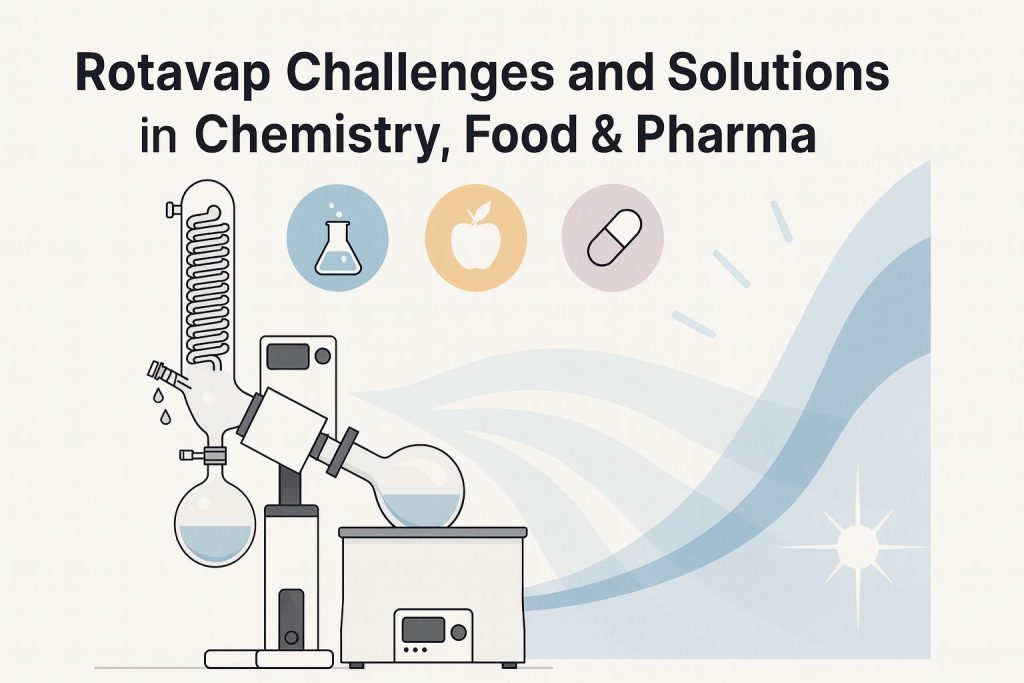
Table of Contents
1) Executive Summary
Evaporation and concentration are fundamental across chemical, pharmaceutical, and food R&D. Rotary evaporators dominate large-volume solvent removal, but face limits with high-boiling solvents, water, or multiple small vials. Smart Evaporators—operating at atmospheric pressure with spiral airflow—solve these issues, enabling bump-free, parallel evaporation directly in vials.
Ready for Safer, Faster, and More Reliable Evaporation?
2) Why Evaporation Still Bottlenecks R&D
- Monitoring burden under vacuum (bumping/splashing risk)
- Transfer losses between flasks and vials
- Slow processing of DMSO/DMF/water-rich samples
- High operator time and energy costs
3) Rotary Evaporator: Strengths & Limits
Rotary evaporators remain reliable for large-scale solvent removal and reaction workups. However, their vacuum operation often leads to bumping and extended run times for high-boilers. Small-vial workflows require repeated setup and constant supervision.
4) Smart Evaporator: Principle, Strengths, and When It Wins
Smart Evaporator technology uses a controlled spiral airflow over the liquid surface at atmospheric pressure. This creates a gentle vortex that accelerates evaporation without bumping. Models like the C1 (single), K4 (4 samples), and C10 (10 samples) let labs scale throughput easily.
Ready for Safer, Faster, and More Reliable Evaporation?
5) Chemical/Materials R&D: Side-by-Side Use Cases
In material synthesis, low-boiling solvents are removed by rotary evaporation, leaving DMF and other high-boilers behind for final drying in the Smart Evaporator. This eliminates transfer steps and bumping.
Citable sources:
・Materials workflow: No.13
・Nottingham University (DMSO): Nottingham University
6) Pharmaceutical R&D: High-Boilers and Parallel Samples
DMSO is essentially impossible to evaporate on a rotovap, while DMF can be removed only under harsh conditions such as deep vacuum, elevated temperatures, and long run times. With the Smart Evaporator, both solvents concentrate within hours, directly in the original vials. Aqueous samples and culture media also benefit from bump-free, unattended drying.
Citable sources:
・High-boilers shortened timelines: No.9
・Reduced DMSO hesitation: No.41
7) Food & Functional-Food R&D
Food labs often need to concentrate multiple fractions (30–100 mL) from chromatography. Smart Evaporator K4 processes several vials in parallel, reducing setup and supervision. Labs report less stress and faster routine throughput.
Citable sources:
・Extracts & activity samples: No.30
・Marine products (parallel K4): No.47
Ready for Safer, Faster, and More Reliable Evaporation?
8) Quick Selector: Which Tool for Which Task?
| Equipment | Best For | Key Strengths | Watch-outs |
|---|---|---|---|
| Rotary Evaporator | Large-volume flasks; reaction mixtures | Established; scalable; broad solvent use | Bumping; small-vial inefficiency; supervision time |
| Smart Evaporator | Small-vial, DMSO/DMF/water samples; parallel work | Bump-free; atmospheric pressure; unattended runs | Not for >50 mL; inert gas may be required |
9) References
- Chem/Materials: No.13, Nottingham University
- Pharma: No.9, No.41
- Food: No.30, No.47
- Smart Evaporator hub: All Testimonials
10) FAQ
Should we replace our rotovap with a Smart Evaporator?
No—use both. Rotovap for bulk flask jobs; Smart Evaporator for small-vial, DMSO/DMF, and parallel evaporation.
Can the Smart Evaporator handle high-boiling solvents like DMSO or DMF?
Yes — and not only those. The Smart Evaporator can efficiently remove both high- and low-boiling solvents, including DMSO, DMF, and even volatile ones, all without bumping. Its strength lies in safely and quickly evaporating small volumes with minimal setup.
Is the Smart Evaporator effective for trace or small-volume samples?
Yes. Its bump-free, gentle evaporation makes it ideal for trace-level and small-volume work. You can concentrate delicate or low-concentration samples safely without loss or contamination.
Ready for Safer, Faster, and More Reliable Evaporation?