Centrifugal Evaporation Explained: Applications, Advantages, and Limitations
Post date : July 09, 2026 Update date : July 09, 2026
Contents
- What Is Centrifugal Evaporation?
- How Does a Centrifugal Evaporator Work?
- Advantages of Centrifugal Evaporation
- Limitations of Centrifugal Evaporation
- Advantages and Limitations at a Glance
- Typical Applications
- When Should You Choose Centrifugal Evaporation?
- Alternative Approach for High-Boiling Solvents
- Frequently Asked Questions
- Conclusion
What Is Centrifugal Evaporation?
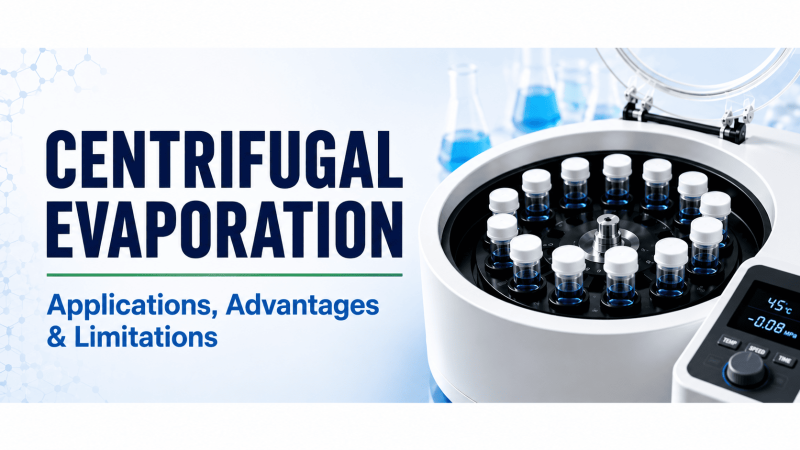
Centrifugal evaporation is a solvent removal technique that combines vacuum, controlled heating, and centrifugal force to concentrate liquid samples. It is commonly used in analytical laboratories where many small-volume samples must be processed simultaneously.
Unlike simple evaporation methods that rely only on heat or vacuum, centrifugal evaporators rotate samples during concentration. This spinning motion helps keep samples at the bottom of the vessel and reduces the likelihood of sample loss caused by splashing or bumping under vacuum conditions.
For this reason, centrifugal evaporation is often used in pharmaceutical research, LC-MS sample preparation, metabolomics, proteomics, environmental testing, and other workflows that require parallel sample processing.
How Does a Centrifugal Evaporator Work?
A centrifugal evaporator works by using three mechanisms at the same time: vacuum, heat, and centrifugal force.
Vacuum
Vacuum lowers the boiling point of solvents, allowing evaporation to occur at lower temperatures than under atmospheric pressure.
Controlled Heating
Heat provides the energy needed for solvent molecules to evaporate. The temperature is typically controlled to support solvent removal while helping protect sensitive compounds.
Centrifugal Force
Continuous rotation keeps the sample positioned in the container during evaporation. This helps reduce sample loss compared with simple vacuum evaporation.
The combination of these mechanisms allows many samples to be concentrated in parallel. However, evaporation performance still depends strongly on solvent properties, sample volume, and system configuration.
Advantages of Centrifugal Evaporation
High Throughput Processing
The biggest advantage of centrifugal evaporation is the ability to process multiple samples simultaneously. Depending on the system configuration, laboratories can concentrate dozens of samples in a single run.
Good Sample Recovery
Centrifugal force helps keep samples contained within tubes, vials, or plates. This supports good sample recovery, especially when working with small or valuable analytical samples.
Suitable for Small Sample Volumes
Centrifugal evaporators are well suited for microcentrifuge tubes, sample vials, and microplates. These formats are commonly used in LC-MS and other analytical workflows.
Useful for Batch Consistency
Because multiple samples can be processed under the same conditions, centrifugal evaporation can help maintain consistency across sample batches.
Limitations of Centrifugal Evaporation
Although centrifugal evaporation is useful for many workflows, it is not the best choice for every concentration task.
High-Boiling Solvents May Require Longer Times
High-boiling solvents can be difficult to remove efficiently, even under vacuum. Examples include DMSO, DMF, NMP, Ethylene Glycol, Propylene Carbonate, and Ethyl Lactate.
For laboratories that frequently use these solvents, evaporation time can become a workflow bottleneck.
System Complexity
Many centrifugal evaporators require vacuum pumps, cold traps, condensers, and rotating assemblies. These components can increase maintenance needs and operational complexity.
Limited Container Flexibility
Centrifugal evaporators often require dedicated rotors, tube holders, or plate adapters. This can limit flexibility when researchers want to use different container types.
Less Suitable for Large Volumes
Centrifugal evaporators are generally optimized for small analytical samples rather than large-volume concentration.
If DMSO, DMF, NMP, Propylene Carbonate, or Ethyl Lactate are common in your workflow,
see how Smart Evaporator™ approaches solvent removal differently.
Advantages and Limitations at a Glance
| Feature | Centrifugal Evaporator |
|---|---|
| Parallel sample processing | Excellent |
| Small sample volumes | Excellent |
| Sample recovery | Excellent |
| High-boiling solvents | Low to Moderate |
| Large-volume concentration | Limited |
| Container flexibility | Limited |
| Maintenance requirements | Moderate to High |
Typical Applications
Centrifugal evaporation is commonly used in laboratories that need to concentrate many small-volume samples in parallel.
- LC-MS sample preparation
- Drug discovery workflows
- Metabolomics
- Proteomics
- Environmental testing
- Forensic analysis
- High-throughput screening
These applications often involve multiple samples and require a balance of throughput, sample recovery, and reproducible processing conditions.
When Should You Choose Centrifugal Evaporation?
A centrifugal evaporator is often a good choice when multiple small-volume samples must be concentrated at the same time. It is especially useful when sample recovery and batch consistency are important.
However, another method may be more suitable when high-boiling solvents are used frequently, when large sample volumes must be concentrated, or when researchers need maximum flexibility in container selection.
Alternative Approach for High-Boiling Solvents
For laboratories working with high-boiling solvents, it is important to evaluate evaporation speed as well as sample throughput. A system that can process many samples at once may still become inefficient if each run requires a long time to complete.
While most laboratory evaporators rely on vacuum to accelerate solvent removal, Smart Evaporator™ takes a different approach.
Using Spiral Plug evaporation technology, Smart Evaporator™ promotes solvent removal under atmospheric pressure, avoiding bumping risk in principle while supporting a wide range of sample containers. This can be useful when researchers need to concentrate high-boiling solvents while maintaining simple operation and container flexibility.
Learn how Smart Evaporator™ helps researchers concentrate challenging solvents under atmospheric pressure. Download the brochure →
Frequently Asked Questions
What is centrifugal evaporation?
Centrifugal evaporation is a concentration technique that combines vacuum, heat, and centrifugal force to remove solvents from multiple samples simultaneously.
Why is centrifugal force used during evaporation?
Centrifugal force helps keep samples contained in the vessel and reduces the likelihood of sample loss caused by splashing or bumping under vacuum conditions.
What solvents are difficult to remove with centrifugal evaporators?
High-boiling solvents such as DMSO, DMF, NMP, Propylene Carbonate, Ethylene Glycol, and Ethyl Lactate may require longer evaporation times.
Are centrifugal evaporators suitable for high-throughput laboratories?
Yes. Centrifugal evaporators are widely used in high-throughput laboratories because they can process many samples simultaneously.
What are the main limitations of centrifugal evaporation?
The main limitations include longer evaporation times for high-boiling solvents, system complexity, dedicated sample holders, and limited suitability for large-volume concentration.
Conclusion
Centrifugal evaporation is a useful solvent removal technique for laboratories that need to concentrate many small-volume samples in parallel. Its main strengths are high throughput, good sample recovery, and compatibility with common analytical sample formats.
At the same time, researchers should consider its limitations. High-boiling solvents may require long evaporation times, and the system may require dedicated accessories, vacuum equipment, and regular maintenance.
When selecting an evaporation method, laboratories should evaluate solvent type, sample volume, throughput needs, container flexibility, and overall workflow efficiency. Understanding both the strengths and limitations of centrifugal evaporation helps researchers choose the most appropriate concentration technology for their work.
Having Trouble Evaporating High-Boiling Solvents?
If your workflow frequently involves high-boiling solvents such as DMSO, DMF, NMP, Propylene Carbonate, or Ethyl Lactate, evaporation time can become a significant bottleneck.
Learn how Smart Evaporator™ helps researchers concentrate challenging solvents under atmospheric pressure while avoiding bumping risk in principle and supporting a wide range of sample containers.