Solvent Evaporation Methods: Choosing the Best Fit
Post date : September 11, 2026 Update date : September 11, 2026
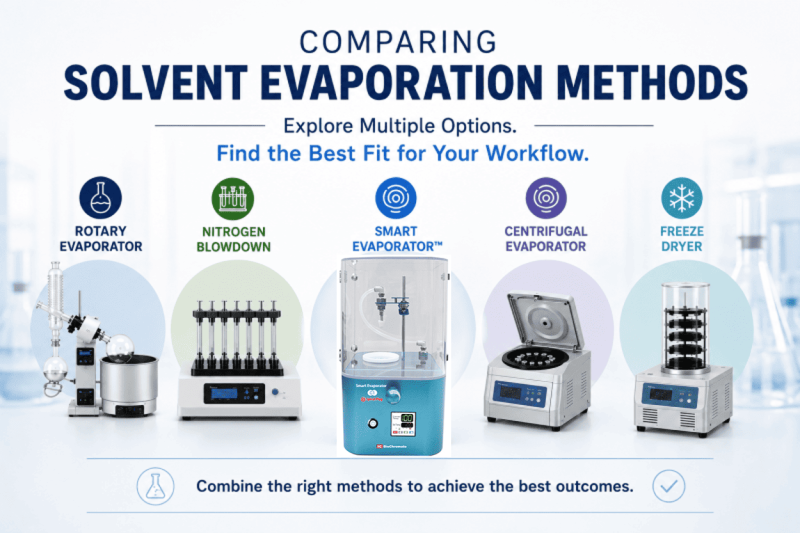
No single solvent evaporation method is ideal for every laboratory application.
Rotary evaporators, nitrogen blowdown, centrifugal evaporators, freeze dryers, and Smart Evaporator™ each offer distinct advantages depending on the solvent, sample volume, container type, and workflow.
Rather than searching for a universal solution, many laboratories achieve greater efficiency by selecting the right method—or combination of methods—for each task.
This guide compares today’s most common solvent evaporation methods, explaining where each technology performs best and how choosing the right combination can optimize laboratory workflows.
Key Takeaways
- Many laboratories use more than one evaporation method to optimize different workflows.
- Nitrogen blowdown, centrifugal evaporators, freeze dryers, and Smart Evaporator™ each serve different applications.
- The best evaporation method depends on solvent properties, sample volume, throughput, and container type.
- No single technology is ideal for every laboratory workflow.
- Choosing the right method can improve efficiency while reducing sample loss and operational complexity.
Quick Comparison
| If you need to… | Consider… |
|---|---|
| Remove medium- to large-volume samples | Rotary Evaporator |
| Process many small samples | Centrifugal Evaporator or Smart Evaporator™ |
| Remove DMSO or DMF | Smart Evaporator™ |
| Dry water-rich samples | Freeze Dryer or Smart Evaporator™ |
| Concentrate volatile solvents simply | Nitrogen Blowdown |
This table is a simplified starting point. The most suitable evaporation method depends on your solvent, sample volume, container format, and workflow requirements.
Table of Contents
- Why Different Workflows Require Different Evaporation Methods
- What Factors Matter Most When Choosing an Evaporator?
- Common Solvent Evaporation Methods
- Comparison Table: Solvent Evaporation Methods
- When Each Method Works Best
- Is There a Single Best Evaporation Method?
- Frequently Asked Questions
- Related Articles
Why Different Workflows Require Different Evaporation Methods
Laboratory evaporation requirements vary widely depending on solvent properties, sample volume, container type, throughput, and experimental objectives. As a result, no single evaporation technology is ideal for every application.
Rather than relying on a single evaporation system for every task, many laboratories improve efficiency by selecting the most suitable evaporation method—or combination of methods—for each workflow.
Different workflows often require different priorities, such as:
- High-boiling solvents such as DMSO or DMF
- Multiple small-volume samples
- Samples in vials, tubes, or non-standard containers
- Workflows where bumping must be minimized
- Applications requiring less hands-on monitoring
- Sample preparation workflows where a round-bottom flask is not convenient
The goal isn’t to find one “best” evaporation method. It’s to choose the right tool—or combination of tools—for the way your laboratory works.
What Factors Matter Most When Choosing an Evaporator?
Different evaporation methods are optimized for different laboratory needs. Before comparing instruments, it is useful to define the most important selection factors.
| Selection Factor | Why It Matters |
|---|---|
| Solvent type | High-boiling solvents may require different evaporation strategies from volatile solvents. |
| Sample volume | Large-volume evaporation and small-volume concentration often require different equipment. |
| Number of samples | Processing many samples in parallel may favor different technologies than evaporating one flask. |
| Container type | Some systems require dedicated vessels, while others support more flexible container use. |
| Bumping risk | Valuable or sensitive samples may require methods that minimize sample loss. |
| Monitoring requirement | Some evaporation methods require frequent supervision, while others allow more walk-away operation. |
Common Solvent Evaporation Methods
Rotary Evaporator
A rotary evaporator removes solvent by rotating a flask under reduced pressure while applying controlled heat. This method is especially common in chemistry laboratories and is well suited to medium- and large-volume solvent removal.
Advantages:
- Effective for medium- to large-volume solvent removal
- Widely used and familiar in many laboratories
- Fast for many common organic solvents
- Well established for flask-based workflows
Limitations:
- Typically requires round-bottom flasks
- Bumping can occur depending on sample and operating conditions
- Less convenient for multiple small samples
- Requires vacuum equipment and condenser management
Nitrogen Blowdown
Nitrogen blowdown evaporates solvent by directing nitrogen gas onto or across the liquid surface. It is commonly used for analytical sample preparation and small-volume concentration.
Advantages:
- Simple operating principle
- No vacuum required
- Suitable for many small-volume samples
- No bumping in principle because the method does not rely on boiling under reduced pressure
Limitations:
- Evaporation speed depends strongly on solvent volatility
- May require monitoring to avoid over-drying
- Can be less suitable for difficult high-boiling solvents
- Continuous gas consumption should be considered
Centrifugal Evaporator
Centrifugal evaporators combine vacuum, controlled heating, and centrifugal force. They are often used when laboratories need to process multiple samples in parallel.
Advantages:
- Excellent for parallel sample processing
- Suitable for many pharmaceutical and life science workflows
- Helps reduce sample loss compared with simple vacuum evaporation
- Good option for high-throughput laboratories
Limitations:
- Requires vacuum
- Container compatibility depends on rotor design
- Equipment cost can be relatively high
- Workflow flexibility may be limited by available accessories
Freeze Dryer
Freeze drying removes water by freezing a sample and sublimating ice under vacuum. Unlike many solvent evaporation methods, freeze drying is primarily designed for aqueous samples and sample preservation.
Advantages:
- Excellent for water-rich samples
- Gentle for heat-sensitive materials
- Useful for long-term sample preservation
- No bumping during conventional liquid boiling
Limitations:
- Generally slow
- Not ideal for many organic solvent removal workflows
- Requires freezing and vacuum operation
- May not fit routine solvent concentration workflows
Smart Evaporator™
Smart Evaporator™ uses Spiral Plug technology to promote solvent evaporation without requiring vacuum. Instead of lowering the solvent’s boiling point, it continuously renews the liquid surface through controlled vortex motion, supporting efficient evaporation under atmospheric pressure.
This approach is useful for laboratories handling high-boiling solvents, multiple small-volume samples, and workflows where container flexibility matters.
Advantages:
- High compatibility with DMSO and DMF
- Fundamentally minimizes bumping
- Supports a wide variety of sample containers
- No specialized glassware required
- Suitable for multiple small samples
- Reduced need for constant monitoring
Considerations:
- Optimized primarily for small- to medium-volume samples
- Large-volume solvent removal may still favor rotary evaporation
Workflow Tip
No single evaporation method is ideal for every laboratory—but the right combination can significantly improve efficiency.
Comparison Table: Solvent Evaporation Methods
The table below summarizes how major evaporation methods compare across common laboratory selection criteria.
| Feature | Smart Evaporator™ | Rotary Evaporator | Nitrogen Blowdown | Centrifugal Evaporator | Freeze Dryer |
|---|---|---|---|---|---|
| Typical sample volume | Small–Medium | Medium–Large | Small–Medium | Small–Medium | Large aqueous samples |
| Processing speed | High | High | Medium | Medium | Slow |
| Bumping risk | Fundamentally minimized | Moderate–High | None | Low | None |
| DMSO compatibility | High | Moderate | Limited | System-dependent | Low |
| DMF compatibility | High | Moderate | Limited | System-dependent | Low |
| Water removal suitability | High | Moderate | Moderate | Moderate | Excellent |
| Container flexibility | High | Limited | High | Limited | Moderate |
| Multiple samples | Good | Limited | Excellent | Excellent | Good |
| Monitoring requirement | Low | High | Moderate | Moderate | Low |
| Vacuum required | No | Yes | No | Yes | Yes |
Actual performance depends on solvent composition, sample properties, operating conditions, and instrument configuration.
When Each Method Works Best
Choose a Rotary Evaporator if…
- You routinely process medium- to large-volume samples.
- Your workflow is based on round-bottom flasks.
- Your solvents evaporate efficiently under vacuum.
- You already have established condenser and vacuum pump infrastructure.
Choose Nitrogen Blowdown if…
- You concentrate small analytical samples.
- You need a simple non-vacuum method.
- Your solvents are sufficiently volatile.
- You can manage gas consumption and endpoint monitoring.
Choose a Centrifugal Evaporator if…
- You process many samples in parallel.
- Your laboratory works with biological or pharmaceutical samples.
- Your containers are compatible with available rotors.
- Vacuum-based evaporation fits your workflow.
Choose a Freeze Dryer if…
- Your samples are water-rich.
- Sample preservation is more important than rapid solvent removal.
- Your materials are heat-sensitive.
- You can allow longer drying times.
Choose Smart Evaporator™ if…
- You frequently remove DMSO, DMF, or water-rich solvents.
- You process multiple small-volume samples.
- You want to fundamentally minimize bumping.
- You need flexibility across different sample containers.
- You want to reduce constant monitoring during evaporation.
- Your workflow does not fit traditional round-bottom flask evaporation.
Looking Beyond a Single Evaporator
Many laboratories use more than one evaporation method, selecting each technology where it performs best.
Explore Smart Evaporator™ applications in the product catalog →
Is There a Single Best Evaporation Method?
No single evaporation method is ideal for every laboratory workflow.
Rotary evaporators remain effective for large-volume solvent removal. Nitrogen blowdown is useful for small analytical samples. Centrifugal evaporators are strong options for parallel processing. Freeze dryers are valuable for water-rich and preservation-focused workflows.
Smart Evaporator™ is one example of an evaporation technology designed for laboratories handling high-boiling solvents, diverse containers, and bump-sensitive samples.
The best choice depends on matching the evaporation method to the sample, solvent, volume, container, and throughput requirements of the workflow.
Frequently Asked Questions
How do I choose the right solvent evaporation method?
The best choice depends on solvent properties, sample volume, throughput, container compatibility, and monitoring requirements. Many laboratories improve efficiency by combining more than one evaporation method rather than relying on a single system.
What is the best alternative to a rotary evaporator?
There is no universal best alternative. The right choice depends on solvent type, sample volume, number of samples, container format, and the required level of monitoring.
Can nitrogen blowdown replace a rotary evaporator?
Nitrogen blowdown can replace rotary evaporation for some small-volume analytical workflows. However, it is generally not intended for larger-volume evaporation or difficult high-boiling solvent removal.
Which evaporation method is suitable for DMSO?
DMSO is a high-boiling solvent, so the suitable method depends on sample volume, endpoint requirements, and workflow format. Smart Evaporator™ can be useful when researchers need to remove DMSO from small- to medium-volume samples while minimizing bumping and supporting flexible container use.
Which evaporation method minimizes bumping?
Bumping is commonly associated with vacuum evaporation and sudden boiling behavior. Methods that do not rely on vacuum boiling, such as nitrogen blowdown and Smart Evaporator™, can avoid bumping in principle.
Can one evaporator handle different container types?
Some evaporation systems require dedicated vessels, flasks, or rotors. Smart Evaporator™ is designed to support a wide range of containers, which can be useful for laboratories working with vials, tubes, and other sample formats.
Conclusion
Modern laboratories have access to a wide range of solvent evaporation methods. Each method has strengths and limitations depending on sample volume, solvent type, throughput, container format, and workflow priorities.
For researchers handling high-boiling solvents, multiple small samples, or diverse containers, selecting the right evaporation method—or combination of methods—can simplify solvent concentration and improve laboratory workflows.
Smart Evaporator™ offers one such option for laboratories that need flexible, bump-free evaporation without relying on traditional rotary evaporation workflows.
Expand Your Laboratory’s Evaporation Options
No single evaporation method is ideal for every laboratory—but the right combination can significantly improve efficiency.
Smart Evaporator™ can complement existing evaporation workflows by supporting high-boiling solvents, multiple small samples, and flexible container formats.