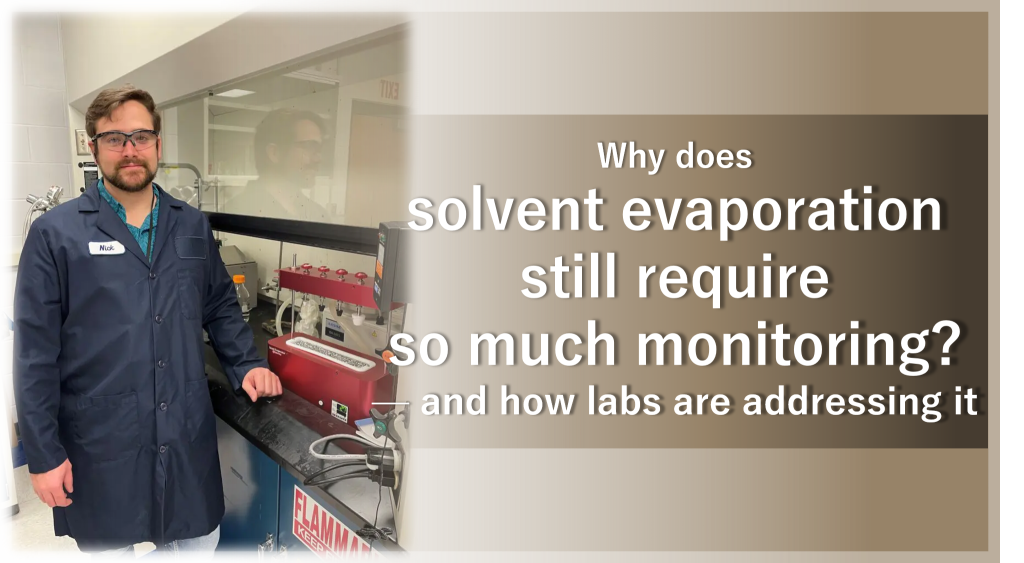
Why does solvent evaporation still require so much monitoring — and how labs are addressing it?
Solvent evaporation is a routine step in many analytical workflows, from environmental testing to materials and pharmaceutical research. Removing solvent and concentrating samples sounds straightforward.
In practice, however, evaporation often requires more attention than expected. Whether working with water, polar solvents such as DMF, or mixed solvent systems, researchers frequently find themselves monitoring progress closely to avoid overdrying, uneven concentration, or sample loss.
This challenge is not the result of poor technique. It reflects the practical limits of conventional evaporation methods under real laboratory conditions. In this article, we explore why solvent evaporation still requires so much monitoring—and how laboratories are addressing it.
→ Looking for a different way to manage evaporation workflows?
See an evaporation approach designed to reduce hands-on monitoring.
Table of Contents
- Evaporation is “routine” — so why isn’t it simple?
- Common frustrations across analytical labs
- A real-world example (Donaldson)
- Where Smart Evaporator fits
- Conclusion
- FAQs
Evaporation is “routine” — so why isn’t it simple?
Solvent evaporation is performed daily in many laboratories. Yet despite its routine nature, it often becomes a step that researchers hesitate to leave unattended.
As solvent volumes decrease, the margin between sufficient concentration and overdrying narrows. This makes it difficult to step away from the process, particularly when handling small volumes or multiple samples in parallel.
Common frustrations across analytical labs
Across different application areas, laboratories report similar challenges during solvent evaporation:
- Frequent visual checks to avoid overdrying
- Difficulty running evaporation unattended
- Longer-than-expected evaporation times for certain solvents
- Inconsistent endpoints when processing multiple samples
These frustrations are not tied to a single solvent or technique. They reflect the practical limits of conventional evaporation methods when applied to real-world laboratory workflows.
A real-world example (Donaldson)
A documented example of these challenges can be seen at Donaldson Filtration Solutions, an industrial manufacturer performing routine solvent evaporation as part of analytical sample preparation.
In their workflow, evaporation was carried out using familiar methods such as nitrogen blowdown and hot plate heating. While these approaches were well established, they required continuous attention and limited how efficiently samples could be processed alongside other laboratory tasks.
To reduce the monitoring burden, the laboratory adopted a different evaporation approach. By changing the evaporation mechanism itself rather than adjusting operating conditions, they reported faster solvent removal and a noticeable reduction in hands-on supervision.
→ Read the full Donaldson case study
Where Smart Evaporator fits
Within this broader context, Smart Evaporator represents one approach that enables evaporation without the risk of bumping by principle. By avoiding reliance on deep vacuum or elevated temperature, solvent can be removed in a controlled and predictable manner.
Because abrupt boiling does not occur, evaporation remains stable even near the final stage. This reduces the need for constant supervision and makes the process easier to manage under conditions that are often challenging for conventional methods.
As a result, this evaporation concept tends to be particularly effective in the following situations:
- Small-volume samples, where conventional methods make it easy to overshoot the endpoint
- Multiple samples requiring consistent evaporation without continuous monitoring
- High-boiling or slow-evaporating solvents such as DMF
- Workflows where reducing hands-on supervision directly improves laboratory productivity
The Donaldson case represents one example of how this principle-based, bumping-free evaporation approach is applied in practice, alongside many other laboratories working under different conditions worldwide.
→ Learn more about Smart Evaporator (Download brochure)
Conclusion
Solvent evaporation becomes challenging not because laboratory techniques are incorrect, but because conventional methods can demand increasingly close supervision under certain conditions.
In workflows involving small volumes, multiple samples, or slow-evaporating solvents, alternative evaporation concepts can help compensate for these challenges. By enabling evaporation under conditions that are not dependent on deep vacuum or elevated temperature, Smart Evaporator allows solvent to be removed without the risk of bumping by principle. This makes it possible for laboratories to reduce monitoring while maintaining control, even in workflows where conventional methods become difficult to manage.
FAQs
Where can I see real laboratory examples using Smart Evaporator?
BioChromato publishes real-world laboratory examples from organizations in Japan, North America, Europe, and other regions. These testimonials describe how laboratories incorporated Smart Evaporator into existing workflows and what operational changes they observed.
→ View global Smart Evaporator testimonials and application examples
Does the need for constant monitoring mean that evaporation is difficult to operate?
Not necessarily. In many cases, monitoring becomes necessary because evaporation behavior changes as sample volume decreases, especially near the final stage. This is a common physical characteristic of solvent evaporation rather than a result of poor technique.
Are conventional methods such as nitrogen blowdown or hot plate evaporation still useful?
Yes. Conventional methods remain effective in many workflows and are widely used. However, when working with small volumes, multiple samples, or slow-evaporating solvents, these methods can require increased supervision, which leads some laboratories to explore alternative approaches.
Why does evaporation become harder to control near the endpoint?
As solvent volume decreases, evaporation rates slow and the margin between sufficient concentration and overdrying becomes narrower. This makes the process more sensitive and often requires closer attention to achieve consistent results.
Is Smart Evaporator intended to replace all existing evaporation methods?
Smart Evaporator is not designed to replace every evaporation technique. It represents an additional option that laboratories may choose when conventional methods become difficult to manage under specific conditions, such as high monitoring requirements or challenging sample types.