
Small Sample Evaporation: University of Nottingham Case Study
Post date : September 11, 2026 Update date : September 11, 2026
At a Glance
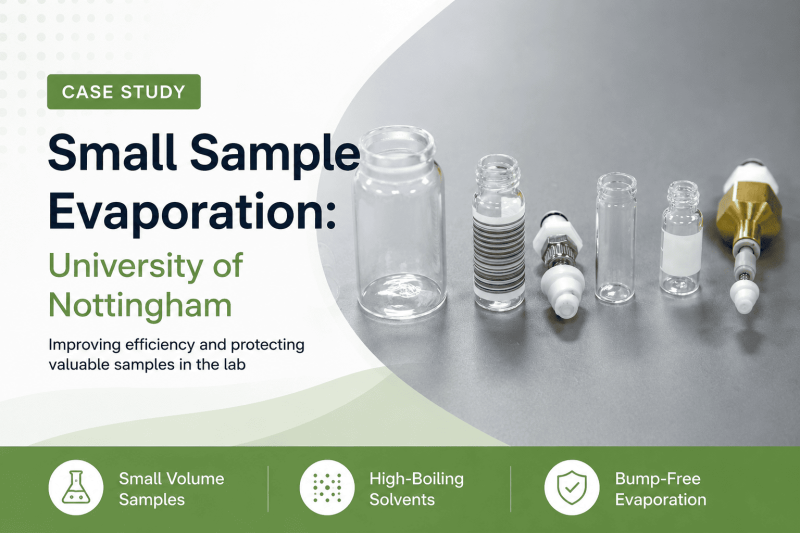
In an undergraduate medicinal chemistry teaching laboratory at the University of Nottingham, Smart Evaporator™ was used to prepare small samples directly in several vial formats, remove DMSO, and free the rotary evaporator for larger-volume work.
- ✓ Direct evaporation in LC-MS vials, screening vials, and recovery vials for NMR samples
- ✓ Bumping and contamination issues were almost completely eliminated
- ✓ Complements rotary evaporator workflows
Rotary evaporators are widely used for solvent removal in chemistry laboratories. However, when researchers need to evaporate small samples directly in LC-MS vials, NMR recovery vials, or other specialized containers, a conventional rotary evaporator may not always provide the most practical workflow.
At the University of Nottingham, researchers encountered difficulties when using a rotary evaporator for small-volume medicinal chemistry samples. Special vial adapters were required, while bumping, contamination, and difficult DMSO removal created additional challenges.
By introducing Smart Evaporator™ alongside its existing rotary evaporator, the laboratory developed a more practical way to prepare small samples for biological screening, LC/MS quality control, and NMR workflows.
Table of Contents
- Why Small-Sample Evaporation Can Be Challenging
- Laboratory Background and Sample Preparation
- Challenges with Conventional Rotary Evaporation
- How Smart Evaporator™ Improved the Workflow
- Evaporation Directly in Different Sample Containers
- DMSO and Other Solvent Evaporation
- Using Smart Evaporator™ Alongside a Rotary Evaporator
- Suitability for Teaching Laboratories
- Workflow Comparison
- Frequently Asked Questions
- Related Resources
Why Small-Sample Evaporation Can Be Challenging
Rotary evaporators are highly effective for removing solvent from relatively large volumes in round-bottom flasks. Their combination of vacuum, controlled heating, and flask rotation makes them a standard tool in many chemistry laboratories.
Small-sample workflows, however, can introduce a different set of practical requirements. Researchers may need to:
- Prepare only a few milligrams of material for biological screening
- Concentrate samples directly in LC-MS or NMR vials
- Handle several different vial formats
- Remove difficult solvents such as DMSO and DMF
- Avoid losing valuable material during sample transfer
- Minimize bumping and cross-contamination
- Keep a rotary evaporator available for larger-volume evaporation
In these situations, adapting a rotary evaporator to handle small vials may add complexity rather than simplify the workflow.
Working with small samples or difficult solvents?
See compatible containers, applications, and product specifications in the Smart Evaporator™ brochure.
Laboratory Background and Sample Preparation
The University of Nottingham uses Smart Evaporator™ particularly in an undergraduate medicinal chemistry teaching module. Students synthesize compounds that are subsequently sent to an industrial pharmaceutical partner for biological screening.
The laboratory prepares 3–5 mg samples for biological screening in vials selected by its industrial partner, together with 1 mg samples for LC-MS analysis. Preparing precise quantities in the required vial format is therefore an important part of the workflow.
The laboratory generally evaporates final compounds after purification by:
- Flash chromatography
- High-performance liquid chromatography (HPLC)
- Solid-phase extraction (SPE)
- Crystallization
By dissolving a known amount of compound and then evaporating it to dryness, the researchers can prepare a precise amount of material in each vial for downstream analysis or biological screening.
Challenges with Conventional Rotary Evaporation
Before introducing Smart Evaporator™, the laboratory used a standard rotary evaporator for these small samples.
To use the required vials with a standard rotary evaporator, the researchers fabricated a special adapter.
According to the testimonial, this approach was not easy to use and created several practical problems.
Special adapters were required
The storage vials, screening vials, recovery vials for NMR samples, and LC-MS vials used by the laboratory required a specially made adapter for use with the rotary evaporator.
Bumping and contamination were serious concerns
According to the University of Nottingham testimonial, bumping and contamination were serious issues with the adapted rotary evaporation setup. This is particularly important when the amount of available compound is limited and replacing the sample may require repeating synthesis or purification.
Small samples occupied the rotary evaporator
The small samples remained on the rotary evaporator for extended periods. During that time, the instrument was unavailable for larger-volume flask evaporation, for which it was more suitable and more frequently needed.
DMSO was difficult to remove
The researchers also reported that removing DMSO with their rotary evaporator was almost impossible. DMSO has a high boiling point and is frequently used in biological screening workflows, making its removal a recurring challenge for medicinal chemistry laboratories.
How Smart Evaporator™ Improved the Workflow
Smart Evaporator™ uses Spiral Plug evaporation technology to promote solvent evaporation under atmospheric pressure. This differs from the vacuum-based operation of a conventional rotary evaporator.
For the University of Nottingham, the main benefit was not simply adding another evaporator. It was assigning small-sample evaporation to equipment better suited to the laboratory’s vial-based workflow.
The researchers reported that Smart Evaporator™ almost completely eliminated the bumping and contamination issues associated with their previous adapter-based setup.
Product Brochure
Learn More About Smart Evaporator™
Explore compatible containers, laboratory applications, product specifications, and available Smart Evaporator™ models.
Evaporation Directly in Different Sample Containers
One of the central advantages reported by the University of Nottingham was the ability to work with several vial formats.
The laboratory uses Smart Evaporator™ with:
- Larger-volume storage vials
- Test vials used by its biological screening partner
- Recovery vials for NMR samples
- LC-MS vials used for quality control
- Small 25 mL round-bottom flasks
Evaporating directly in the required container can reduce the need for an additional transfer step after concentration. This is particularly relevant when only a few milligrams of material are available.
In this case, container flexibility allowed the laboratory to prepare samples in the vial formats required for partner screening, NMR recovery, storage, and LC-MS quality control.
DMSO and Other Solvent Evaporation
DMSO is widely used to dissolve compounds for biological assays and screening. However, its high boiling point makes it more difficult to remove than many common organic solvents.
The University of Nottingham reported that DMSO removal worked well with Smart Evaporator™, while it had been almost impossible with the laboratory’s rotary evaporator workflow.
The laboratory also used the system for other post-synthesis solvent-removal tasks, including:
- Removing acetonitrile and DMF to facilitate solvent exchange during work-up
- Taking water and methanol samples to dryness after SPE
- Drying final compounds after flash chromatography, HPLC, SPE, or crystallization
- Preparing known quantities of compounds in individual vials
Evaporation performance depends on the solvent, sample amount, vessel, temperature, and other operating conditions. Each workflow should therefore be evaluated under its own laboratory conditions.
Using Smart Evaporator™ Alongside a Rotary Evaporator
The Nottingham testimonial shows how the two instruments were assigned to different tasks within the same laboratory. The rotary evaporator was more often needed and better suited for larger-volume flask evaporation, while Smart Evaporator™ handled the small vial-based samples.
A rotary evaporator remains highly effective for larger solvent volumes in round-bottom flasks. Smart Evaporator™ can complement it by handling small samples, high-boiling solvents, and containers that are inconvenient to attach to a rotary evaporator.
Separating these tasks can help prevent small samples from occupying a rotary evaporator that is needed for large-volume evaporation.
Suitability for Teaching Laboratories
Ease of operation was another important benefit in this case.
According to the testimonial, undergraduate students found Smart Evaporator™ easy to use without supervision. They were also keen to continue using it because they found it easier to operate than the rotary evaporators used in the laboratory.
In this teaching laboratory, the students’ ability to use the instrument without supervision was a practical benefit. Training and operation should still follow each institution’s safety procedures.
Workflow Comparison
| Workflow Consideration | Rotary Evaporator | Smart Evaporator™ (Atmospheric-pressure evaporation) |
|---|---|---|
| Larger solvent volumes | Well suited | Not its primary application |
| Small sample vials | An adapter may be required | Direct evaporation in compatible vials |
| Container flexibility | Primarily round-bottom flasks | Supports multiple vial and vessel formats |
| Sample transfer | May be required for final vial preparation | Can often evaporate in the final container |
| Bumping | Possible under vacuum | Fundamentally minimized |
| DMSO removal in this case | Reported as almost impossible | Reported to work well |
| Small-sample equipment availability | Small samples may occupy the main rotary evaporator | Allows the rotary evaporator to remain available for larger samples |
| Teaching laboratory operation | Reported as more difficult for students | Reported as easy to use without supervision |
The appropriate evaporation method depends on sample volume, solvent, container, required endpoint, and laboratory conditions.
Frequently Asked Questions
Can Smart Evaporator™ replace a rotary evaporator?
Smart Evaporator™ does not necessarily replace a rotary evaporator. The two instruments can be used for different purposes. Rotary evaporators are generally well suited to larger volumes in round-bottom flasks, while Smart Evaporator™ can support small-volume samples, high-boiling solvents, and vial-based workflows.
Can Smart Evaporator™ remove DMSO?
Yes. The University of Nottingham reported that DMSO removal worked well with Smart Evaporator™, whereas removing DMSO with its previous rotary evaporator workflow had been almost impossible. Actual evaporation performance depends on sample conditions and operating parameters.
Can samples be evaporated directly in LC-MS vials?
Smart Evaporator™ supports direct evaporation in various compatible containers. In the Nottingham laboratory, it was used with LC-MS vials, NMR recovery vials, storage vials, screening vials, and small round-bottom flasks.
Does Smart Evaporator™ prevent bumping?
Smart Evaporator™ promotes evaporation under atmospheric pressure rather than by reducing pressure around the sample. In the Nottingham case, the researchers reported that it almost completely eliminated the bumping and contamination problems experienced with their rotary evaporator adapter.
Is Smart Evaporator™ suitable for teaching laboratories?
In this case study, undergraduate students used Smart Evaporator™ without supervision and found it easier to operate than the laboratory’s rotary evaporators. Suitability should still be evaluated according to each institution’s safety procedures and training requirements.
What sample scale was used at the University of Nottingham?
The laboratory reported working at approximately 2–50 mg per mL. It prepared approximately 3–5 mg samples for biological screening and approximately 1 mg samples for LC-MSanalysis.
Product Brochure
Learn More About Smart Evaporator™
Explore laboratory applications, compatible sample containers, product specifications, and available models in the Smart Evaporator™ brochure.