
DMSO Evaporation in Medicinal Chemistry: Reclaiming Precious NMR Samples Beyond Rotary Evaporator Limits
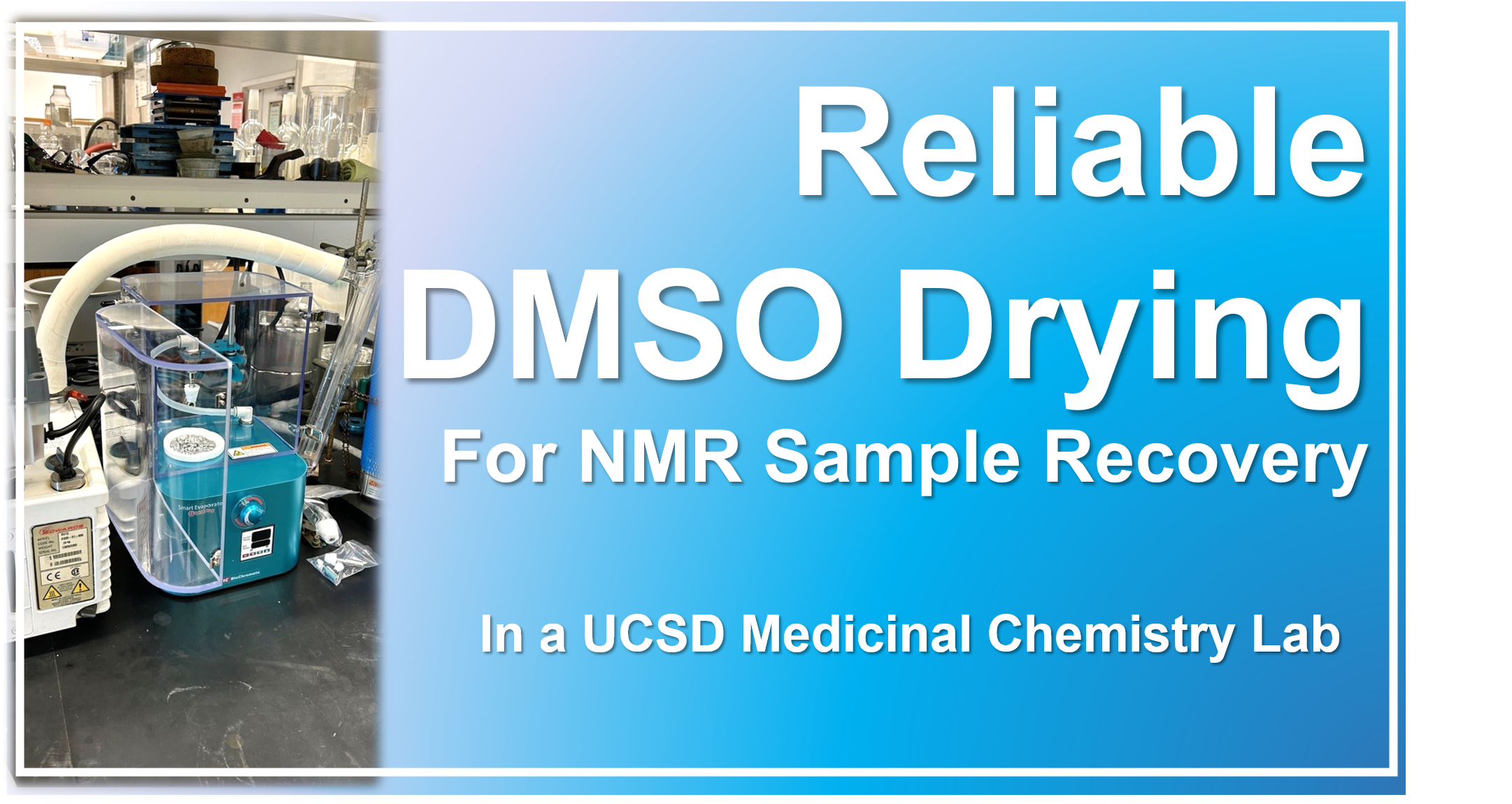 Looking to evaporate DMSO safely? While rotary evaporators can remove DMSO, the final stage often becomes sensitive to pressure changes and requires close monitoring. When the UCSD medicinal chemistry lab began using the Smart Evaporator by BioChromato, operating under atmospheric pressure, they achieved more stable concentration to dryness and simplified NMR sample recovery.
Review technical details for safe DMF evaporation (catalog download)
The Challenge: DMSO and Small-Volume Samples
DMSO has a high boiling point and is widely recognized as one of the more difficult solvents to remove efficiently. In vacuum-based systems, evaporation often slows near dryness, and the process becomes increasingly sensitive to pressure or temperature fluctuations.
For medicinal chemistry laboratories working with small, valuable NMR samples, this sensitivity can increase the risk of bumping or sample loss—especially during the final stage when the margin between “concentrated enough” and “overdried” becomes narrow.
Using a Rotary Evaporator for DMSO
The rotary evaporator (rotovap) is a standard tool for solvent removal in research laboratories. For volatile solvents, it performs efficiently and reliably.
However, when applied to DMSO:
- Stronger vacuum is typically required, which can increase endpoint sensitivity.
- Higher bath temperatures may be used, which can be undesirable for heat-sensitive compounds.
- Evaporation becomes harder to control near dryness, where pressure shifts can trigger sudden boiling.
- Bumping risk increases if boiling behavior changes abruptly.
- Closer monitoring is often necessary, particularly in the last stage.
In other words, a rotary evaporator can remove DMSO, but “it works” is not always the same as “it works predictably with minimal oversight,” especially for small-scale NMR workflows.
In contrast, see how atmospheric-pressure evaporation addresses these challenges. (catalog download)
Evaporating DMSO Without Vacuum Dependency
At the University of California, San Diego (UCSD), researchers in the Department of Chemistry and Biochemistry frequently handle small quantities of valuable compounds in medicinal chemistry and drug design workflows. According to the UCSD testimonial, the lab often concentrates samples to dryness and reclaims NMR samples from many solvents, including DMSO.
In this context, reproducibility and compound protection matter as much as throughput. Instead of relying on deep vacuum, the lab implemented the Smart Evaporator, which operates under atmospheric pressure using controlled vortex gas flow.
Because evaporation does not depend on pressure reduction:
- Vacuum-induced bumping is fundamentally minimized by principle.
- Pressure fluctuations do not destabilize the process in the same way as vacuum workflows.
- The final stage of evaporation becomes more predictable when concentrating samples to dryness.
- Continuous monitoring is reduced compared to conventional vacuum systems.
The UCSD testimonial also highlights low-temperature evaporation as beneficial for drying sensitive compounds while enabling effective concentration to dryness.
Learn the technical overview: Smart Evaporator product page
Summary – Practical Outcomes Observed
Based on the UCSD testimonial, the lab reported being able to concentrate small amounts of precious samples to dryness effectively. They also described improved ease of reclaiming NMR samples from many solvents—including DMSO—while emphasizing low-temperature evaporation to support sensitive compounds.
- Reliable DMSO evaporation to dryness for small-volume samples
- Simplified NMR sample recovery with reduced operational sensitivity near the endpoint
- Less monitoring than conventional vacuum systems during solvent removal
- Low-temperature conditions to support compound integrity
Rotary vs Atmospheric Evaporation
| Aspect | Rotary Evaporator (Vacuum-Based) | Smart Evaporator, VVC system(atomospheric pressure system) |
|---|---|---|
| Primary driver | Vacuum + rotation + heating | Gas flow under atmospheric pressure |
| DMSO removal practicality | Often needs strong vacuum and closer endpoint control | Designed to remove challenging solvents without relying on deep vacuum |
| Bumping near dryness | Can occur if pressure/boiling behavior shifts suddenly | Minimized by principle due to non-vacuum dependency |
| Monitoring burden | Commonly higher near the endpoint | Reduced supervision required |
| Small-vial handling | Typically optimized for round-bottom flasks; vials may require adapters | Designed for direct use with vials and small containers |
Frequently Asked Questions About DMSO Evaporation
Can you evaporate DMSO using a rotary evaporator?
Yes. A rotary evaporator can remove DMSO. However, because DMSO has a high boiling point, stronger vacuum and/or elevated temperatures are often used. Near dryness, evaporation can become harder to control and may require closer monitoring. Some laboratories explore VVC system(atomospheric pressure system), such as the Smart Evaporator by BioChromato, to reduce vacuum-related instability.
Why does DMSO evaporation become unstable near the endpoint?
As solvent volume decreases, evaporation rates slow and the system becomes more sensitive to pressure or temperature fluctuations. In vacuum systems, even small pressure changes can trigger sudden boiling, increasing the risk of bumping and sample loss. Atmospheric-pressure approaches, including the Smart Evaporator, avoid deep vacuum dependency and can provide more stable endpoint control.
Is it possible to evaporate DMSO without vacuum?
Yes. Atmospheric-pressure evaporation systems can remove DMSO without reducing pressure. By avoiding vacuum dependency, the mechanism that commonly causes bumping in rotary evaporator workflows is minimized. One example is the Smart Evaporator by BioChromato, a VVC system(atomospheric pressure system) that removes solvent without relying on deep vacuum.
How can I reclaim NMR samples safely?
Maintain controlled temperature conditions, avoid sudden pressure shifts, and reduce mechanical disturbance. Stable evaporation conditions improve reproducibility when working with small volumes of valuable compounds. For small-volume NMR sample recovery, VVC system(atomospheric pressure system) such as the Smart Evaporator can be particularly effective. Because solvent removal occurs without reducing pressure, the mechanism that typically causes bumping in vacuum systems is fundamentally avoided, allowing more stable concentration to dryness.
When should I consider alternatives to a rotary evaporator?
Rotary evaporators remain a practical choice for many solvents and workflows. If you often work with small, high-value samples or challenging solvents like DMSO—especially when bumping risk and endpoint sensitivity increase—it can make sense to add an atmospheric-pressure option such as the Smart Evaporator alongside your rotary evaporator. Many labs use both, choosing the tool that best fits the solvent, sample volume, and risk tolerance.
Primary links:
- UCSD testimonial page
- Donaldson laboratory case study – Workflow-focused example of reduced monitoring in routine solvent removal
- Smart Evaporator product page
Review technical details for safe DMF evaporation, Smart Evaporator (catalog download)