
Evaporate high- and low-boiling solvents without exposing the sample to deep vacuum.
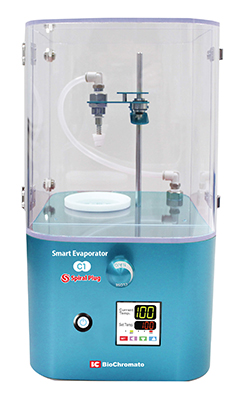
Smart Evaporator™ uses a specially engineered Spiral Plug to generate controlled spiral airflow inside the sample vessel. Rather than relying on deep vacuum, it promotes solvent evaporation while avoiding the conditions that cause vacuum-induced bumping.
How the Spiral Plug Creates Spiral Airflow
The Spiral Plug is a specially engineered component with precision-machined spiral grooves that generate controlled airflow inside the sample vessel.
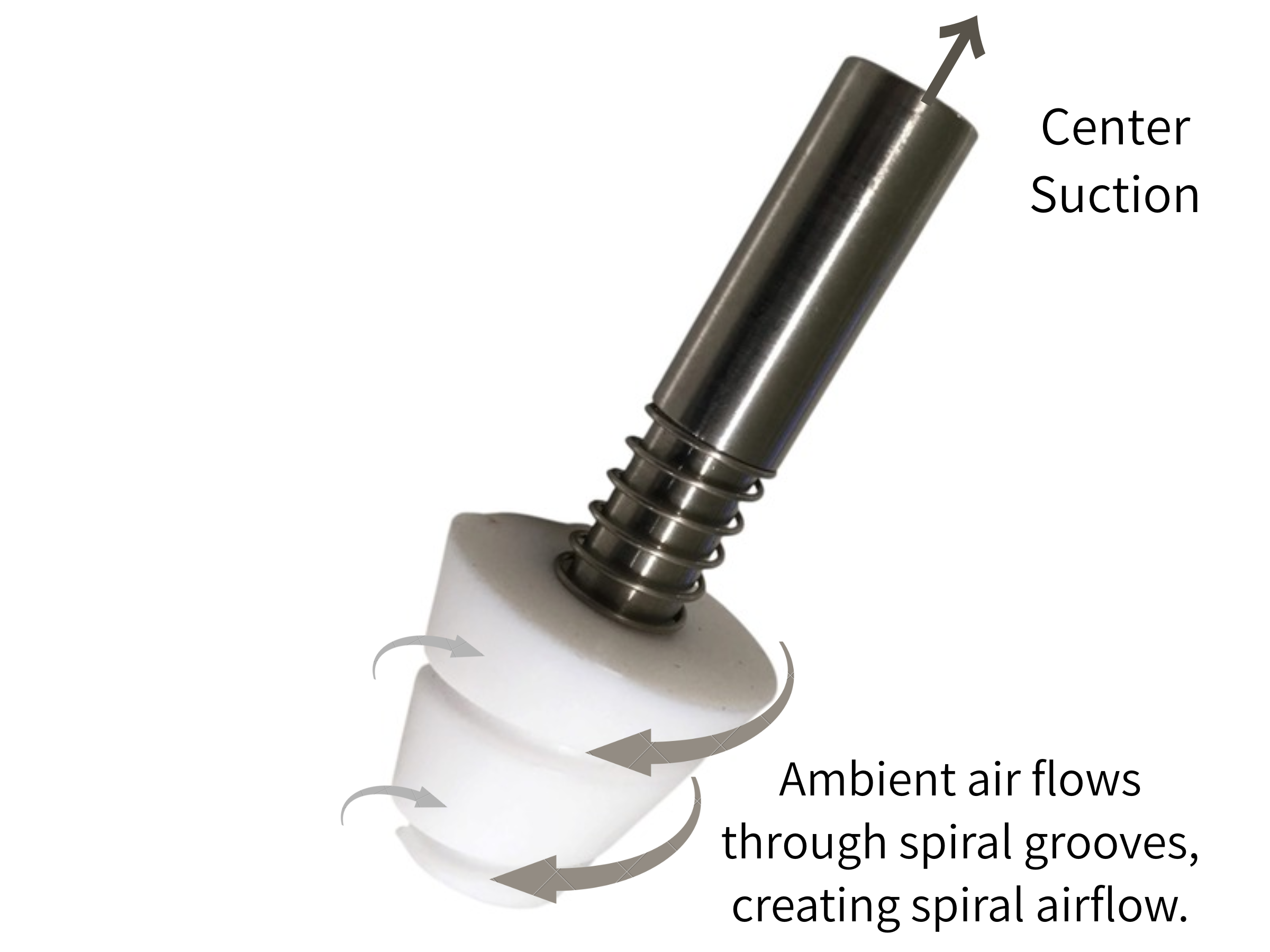
Two simultaneous actions generate spiral airflow
- 1. Continuous suction
When suction starts, solvent-rich vapor is continuously withdrawn through the center of the Spiral Plug. - 2. Controlled air intake
At the same time, ambient air enters through precision-machined spiral grooves in the plug, creating rotating airflow inside the sample vessel.
Together, these two actions continuously renew the liquid surface, increase liquid–gas contact, and promote solvent evaporation. Because the vessel remains close to atmospheric pressure, the conditions that cause vacuum-induced bumping are avoided in principle.
The animation below demonstrates how the Spiral Plug generates continuous spiral airflow inside the sample vessel.
How Smart Evaporator™ Promotes Solvent Evaporation
The Spiral Plug generates spiral airflow, increasing liquid–gas contact and promoting solvent evaporation.
Watch how the Spiral Plug generates spiral airflow inside the sample vessel.
The Evaporation Process
1. Pump establishes suction
The pump creates suction at the outlet.
2. Atmospheric gas enters
Gas is drawn through the Spiral Plug’s spiral groove.
3. Spiral airflow forms
The incoming gas generates spiral flow inside the vessel.
4. Surface area increases
The spiral flow agitates the sample and increases liquid–gas contact.
5. Solvent volatilization is promoted
Solvent-rich vapor is continuously removed by the pump.
The following data show example evaporation times for 5 mL samples in a 20 mL vial under specified test conditions.
| Solvent / Quantity | Suction Flow Rate | 40°C | 70°C |
|---|---|---|---|
| Water / 5 mL 20 mL vial | 29–30 L/min | 49 min. | 28 min. |
| DMF / 5 mL 20 mL vial | 20–30 L/min | 43 min. | 24 min. |
| DMSO / 5 mL 20 mL vial | 23–30 L/min | 195 min. | 69 min. |
| NMP / 5 mL 20 mL vial | 25–30 L/min | NA | 71 min. |
Results vary depending on solvent volume, vessel shape, temperature, airflow, and sample conditions. Data shown are example test results.
Have a difficult solvent or sample condition?
Related Resources
Explore applications, workflow benefits, and experiences from Smart Evaporator™ users.
Container Flexibility
In-Vial Concentration
Learn how samples can be concentrated directly in common laboratory vials and tubes, helping reduce transfers and simplify downstream workflows.
Application
Aqueous Sample Concentration
See how Smart Evaporator™ can support the concentration of water-based samples without relying on deep vacuum or solvent exchange.
Customer Stories
Customer Testimonials
See how researchers use Smart Evaporator™ in teaching, medicinal chemistry, sample preparation, and other laboratory workflows.
Frequently Asked Questions
Common questions about the operating principle and applications of Smart Evaporator™.
Why does Smart Evaporator™ minimize bumping?
Smart Evaporator™ does not use rapid pressure reduction to promote evaporation. Instead, the Spiral Plug generates controlled spiral airflow inside the vessel. Because the sample is not exposed to deep vacuum, vacuum-induced bumping is avoided in principle.
Can Smart Evaporator™ evaporate DMSO, DMF, NMP, and water?
Yes. Smart Evaporator™ can be used with high-boiling solvents including DMSO, DMF, NMP, and water. Evaporation time varies according to solvent volume, vessel shape, temperature, airflow, and sample conditions.
Does Smart Evaporator™ require a vacuum pump?
A diaphragm pump is used to establish suction and continuously remove solvent-rich vapor. However, the pump does not expose the sample to deep vacuum in the same way as a conventional vacuum evaporator.
What types of containers can be used?
Depending on the model and accessory configuration, Smart Evaporator™ supports a range of common laboratory containers, including glass vials, centrifuge tubes, test tubes, LC-MS vials, and sample bottles.
What sample volume is recommended?
Smart Evaporator™ is commonly used for small-volume samples, with approximately 1–30 mL being a typical working range. The supported volume depends on the selected model, vessel, solvent, and operating conditions.
Is Smart Evaporator™ suitable for heat-sensitive samples?
Operating temperature can be selected according to the solvent and application. Suitability for a heat-sensitive sample should be assessed based on the sample properties, required temperature, concentration endpoint, and processing time.
Need Help Choosing the Right Configuration?
Tell us about your solvent, sample volume, and container. We’ll help you find the Smart Evaporator™ configuration that best fits your application.