USER TESTIMONIAL
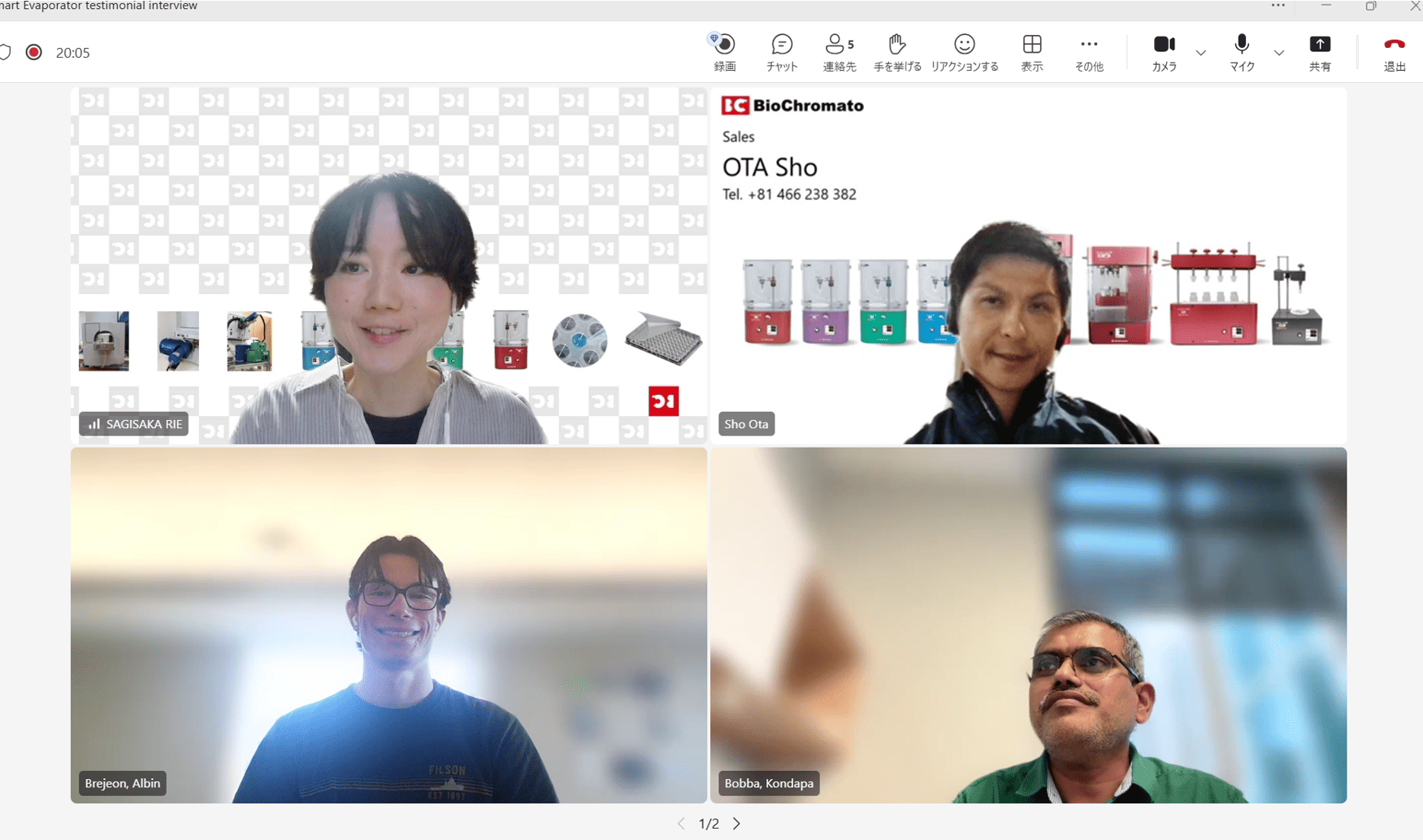
Dr. Kondapa Naidu Bobba and Albin Brejeon
University of Tennessee, Knoxville
Dr. Bobba’s research group at the University of Tennessee, Knoxville uses the Smart Evaporator™ to concentrate small-volume samples after purification in radiopharmaceutical research.
RESEARCH FIELD
Radiopharmaceutical research
SYSTEM
Q1
What kind of research do you conduct?
Our laboratory conducts research and development of radiopharmaceuticals.
We use the Smart Evaporator™ mainly after purification by HPLC or C18 cartridges. After purification, we need to remove most of the solvent and concentrate the purified sample for the next step.
Our samples are usually small-volume solutions, typically around 1–2 mL.
Q2
How do you use the Smart Evaporator™ in your laboratory?
We use the Smart Evaporator™ when purified samples need to be concentrated after HPLC or C18-cartridge purification.
Several members of our laboratory use the system. We typically use it once or twice per month when post-purification evaporation is required.
Q3
How did you first learn about the Smart Evaporator™?
I had previously used the Smart Evaporator™ while working in Korea, so I was already familiar with the system and how to operate it.
Q4
What do you find useful about the Smart Evaporator™?
One of the main advantages for our laboratory is its compact size.
We are a relatively new laboratory, so having an evaporation system that does not take up much benchtop space is useful.
The system is also simple and easy to handle.
“We are happy with it.”
— Albin Brejeon, University of Tennessee, Knoxville
Q5
What are your typical operating conditions?
Our typical sample volume is approximately 1–2 mL, and we use small glass vials with a capacity of around 5 mL.
Our samples mainly contain water, ethanol, ethanol-water mixtures, or saline.
We normally set the temperature at approximately 40–50°C.
For 1–2 mL of water, evaporation usually takes approximately 10–15 minutes, although we have not formally measured the evaporation time.
We do not apply a strong vacuum immediately. Instead, we gradually increase the vacuum and apply a stronger vacuum toward the end of the evaporation process to complete drying.
We also appreciate that bumping does not occur during evaporation.
Q6
Is there anything you would like to see improved?
Overall, the Smart Evaporator™ has met our expectations, and we are happy with it. We have not identified any significant issues.
Q7
Are there any other approaches you would like to try?
During the interview, we discussed ways to shorten the evaporation time, including adjusting the heating conditions and using nitrogen through the gas supply port.
We would like to try these approaches and see how they work for our samples.
KEY TAKEAWAY
Compact Evaporation for Small-Volume Radiopharmaceutical Samples
In Dr. Bobba’s laboratory, the Smart Evaporator C1 is used to concentrate small-volume samples following HPLC or C18-cartridge purification.
With typical sample volumes of approximately 1–2 mL, the compact benchtop system provides a practical way to perform solvent removal within the radiochemistry laboratory.
Its small footprint and ease of handling make it particularly suitable for a newer laboratory where benchtop space is limited.
Looking for a Compact Solution for Small-Volume Evaporation?
Explore the Smart Evaporator™ in more detail or see how it could fit your small-volume evaporation workflow in a short live demo.